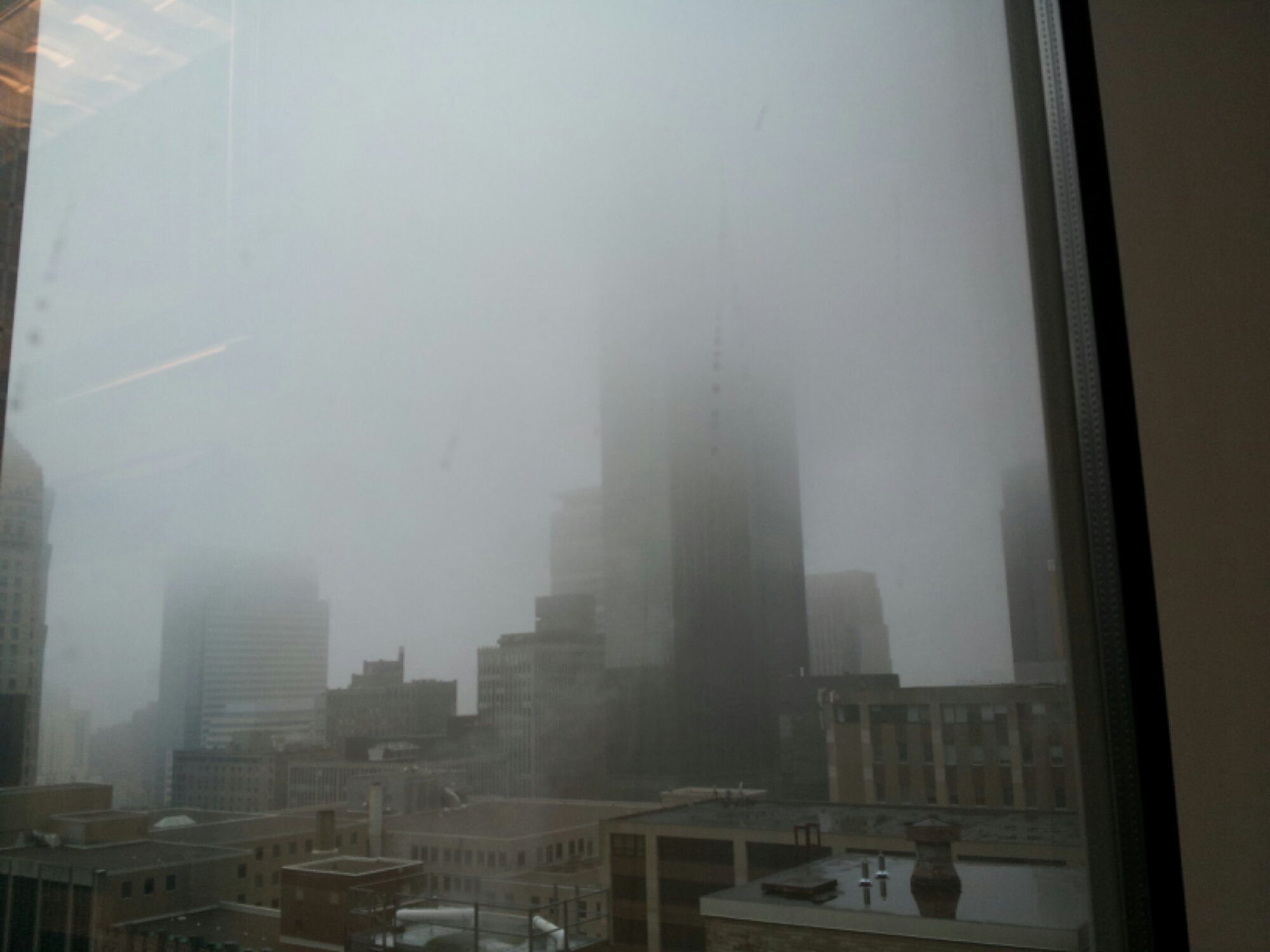
Foggy day in Minneapolis. That’s the bottom half of the IDS Center.

Image

image

World Series Games Four and Five: Cardinals Go Flat, Ortiz the Alpha

After the obstruction call decided the third game in their favor, the Cardinals have gone flat. This means that they can’t hit when it counts, and in this case, they aren’t hitting at all getting six hits in the fourth game and only four last night in a quiet 3-1 loss. Thus the last two games have been Red Sox victories without serious Cardinals challenges. 

The Fourth Game did have its moment with Kolten Wong, on first running for Allen Craig, was picked off to end the game. Where game three was the first World Series Game that ended on an obstruction call, this was the first World Series game that ended on a pickoff.  The fifth game ended without drama. Trevor Rosenthal struck out three Red Sox in the top of the inning and Koji Uehara got a called third strike, (the zone was a bit enlarged in this game!!) and ground ball out and a fly ball third out to end the game.

The drama here is the continued batting exploits of the Red Sox David Ortiz. He went 3 for 4 last night and is batting. 733 for the series. He was 3-3 in the fourth game, 1-2   with two walks in the third, 2-3 one walk in the second and 2-3 in the first game,  that is 11 hits in 15 World Series at bats. I am sure the folks at Elias Sports will give us the historical perspective soon. For example, he reached base on nine consecutive at-bats, a World Series and is batting over. 450 for his World Series career of thirteen games. What is  most surprising is that Ortiz came to Major Leagues in 1997 as a Minnesota Twin, and was released by them after the 2002 season. Released!!! The Twins were trying to make him a “slap hitting, go to left with soft line drives like Mauer hitter,” and the man who would be known as Big Papi wanted to just hit it hard. Boston signed him after the Twins released him and allowed him to do just that. Maybe the Twins should have had Mauer hit like Ortiz instead.

David Ortiz is the Red Sox Alpha, that leader who sets the stage for the others, and he will win this World Series, unless, of course, the baseball gods think differently.  Like those on Mount Olympus in ancient days, these gods don’t like perfection which they reserve for themselves and like to prove to heroes that they are mere mortals after all.

Let’s see what happens here, I am betting on David Ortiz. 

World Series Game Three: A Rarely Used Rule Decides the Game

Last night’s game in St. Louis ended with an umpire’s ruling that Red Sox third baseman, Will Middlebrooks, obstructed the Cardinal’s Allen Craig’s effort to score on a throw that got past Middlebrooks.   The situation is as follows. The game was in the bottom of the ninth iñning tied at 4-4. After one out, Molina singled off Brandon Workman and Manager Farrell brought in closer Koji Uehara and Allen Craig doubled on the first pitch putting runners on second and third with one out.

(NOTE: This was the third game between these two very good teams and such teams know how to win games. The hitters have seen the pitchers now, and are starting to figure out how to hit them. Koji Uehara likes to throw first pitch strikes and seldom walks hitters, so attacking the first pitch is the smart move. In the top of the eighth inning, the Red Sox had scored when Daniel Nava, facing the remarkable Trevor Rosenthal on a 0-2 pitch, hit it “up the middle” to score the tying run. This is the way many tight games are decided when smart players do the smart thing. Both Craig and Nava did the smart thing against a pitcher with whom they were now familiar.)

Then the fun started.  John Jay hit the ball sharply to second and Justin Pedroia, one the the handfull of players around who make the great play when necessary, made one here by diving to his right, fielding the ball and throwing home to beat Molina. On the play, Craig advanced to third and Jarrod Saltalamacchia threw just a bit to Middlebrooks’ left and the ball glanced off Craig’s arm. Middlebrooks dove to catch the throw and was lying on the ground, his feet even with the bag and his body between Craig and homeplate. If he remained still, the outcome may have been different, but he raised his lower legs and Craig attempted to step over him on his way home; he tripped. The umpire immediatley ruled obstruction and awarded Craig home even though Nava’s throw from left beat the runner to the plate. It was the correct call. The time from Jay’s swing to Craig’s run took less than 15 seconds.

The rule invoked at this time was Official Playing Rule 7.06 that says “obstructed runners shall be awarded one base. . . ,” and 7.09J says “obstruction. .  . should be called only in very flagrant and violent cases. . .” The definitional section under Rule 2.0 defines Obstruction as the act of a fielder, while not in possesion of the ball and not in the act of fielding the ball, impedes the progress of any runner.” “Impede” is a sufficiently
vague term to allow some prosecutorial lattitude. Had Middlebrooks dove in the act of attempting to field the ball and had stayed there, Craig would have had to step over him to advance home. Even if Craig tripped stepping over Craig, no obstruction would have been called, but he made an overt act that materially impeded Craig. Middlebrooks did the smart act; he tried to prevent the run. The umpire exersized his prosecutorial lattitude and ruled it Obstruction and 2013 World Series Game Three became the only such game to be decided on such a call.

When I spent my time studying the rules, I once asked a senior umpire about the play where a batter hits a swinging bunt in front of the plate and the runner and catcher collide while the runner is attempting to run to first and the catcher is attempting to field the ball. It is the collision of the “Interference Rule,” where a runner interfers with the fielder while fielding a ball, and the “Obstruction Rule.” The umpire looked at me and said, “Clark, that would be an act of God.” Such is baseball.

Prime Time Sports and Entertainment Conference in Toronto November 11-12.

This is one of the premier sports and entertainment symposiums of the year. Read below for detail regarding subject matter and participants. 
 

Leading Edge Strategies for Managing and Marketing the Business of Sport

The 6th Annual Prime Time Sports Management Conference and Trade Show
November 11-12, 2013
Westin Harbour Castle Hotel
Toronto, Canada


Do not miss this great event !
Hurry Up & Register


Missed the 2012 PrimeTime Sports Management Conference?

Click on the link below to purchase FULL ACCESS to conference videos from the 2012 Sports Management Conference, PLUS the entire 2011 Sports Management Conference!

2012 Sports Management Conference

2013 Brochures:
Click here to Download the 2013 Sponsorship Brochure

Click here to Download the 2013 Trade Show Brochure

Download the 2013 PrimeTime Sports Management Conference Agenda

Join the PrimeTime Sports & Entertainment Newsletter
We’ll send you updates and exclusive offers!

Welcome to PrimeTime Sports and Entertainment

The 6th Annual PrimeTime Sports Management Conference and Trade Show will be held on Monday, November 11 and Tuesday, November 12, 2013 at the Westin Harbour Castle Hotel in Toronto.


PrimeTime Sports & Entertainment Inc. is a Toronto-based management and consulting firm founded by Brian Burke and Trevor Whiffen which provides a unique range of services dealing with the business of sports.
Drawing upon its extensive network of contacts in the sports and entertainment industry,PrimeTime has established itself as a leader in the field of sports and event management,consulting, education,


media training and networking. The principal goal of PrimeTime is to provide members of the sports industry with an opportunity to work with and learn from leading industry experts regarding the representation of athletes and the challenges of operating professional teams, leagues, facilities and media outlets.


Past Speakers Include
  • Kevin Abrams

    Assistant General Manager,
    New York Giants

    Kevin Abrams is in his 11th season as the Giants’ Assistant General Manager after serving for three years as the team’s Salary Cap Analyst. Read More

  • Gary Bettman

    Commissioner,
    National Hockey League

    Born in New York, Gary Bettman was an avid New York Islanders fan growing up in Queens. Prior to assuming his role as Commissioner of the NHL .. Read More

  • Bill Polian

    NFL Analyst and Former President and Vice Chairman ,
    Indianapolis Colts

    Bill Polian was the President and Vice Chairman of the Indianapolis Colts of the National Football League from 1998 to 2011 .. Read More

  • Ned Colletti

    General Manager,
    Los Angeles Dodgers

    Ned Colletti enters his eighth season as General Manager of the Los Angeles Dodgers, making him the fifth-longest tenured GM in the National League .. Read More


Click Here to View the List of All Past Speakers

“I thought this year’s panels were excellent, thanks in large part to the strength of the panellists, who were well-informed and well spoken.”
Gord Miller

The Sports Network
Gord Miller

Click here to view more testimonials

2013 Sports Management Conference Timeline

Download the 2013 PrimeTime Sports Management Conference Agenda

Thank You to Our Corporate Partners


scotiabank


simplycast
Dickinsonwright
fau
ryerson university
tsn
CroweSoberman-Logo
smww
suttonspecialrisk


pavliks.com


Sportsnetworker
COLTHockey
Maple Leafs Logo
London Knights Logo
Molson Logo
OHL
Sportsnet-590-THE-FAN
Score Mobile Logo
Internet Marketing
Exportise Logo


Humber College Logo


JD Communication Design Logo
merit
Jet Ice


Kudlow & Mccann Logo


Manatt Logo


Pokerstars Logo


PTC Accounting & Finance Inc. Logo


You Can PLay Logo


Dream Bridge Exchange Logo


Contact Us

Patrice Whiffen
Director of Marketing, Events & Media
(519) 868-2399
patricewhiffen@primetimesport.ca
199 Bay Street Suite #2200,
P.O. Box 447
Commerce Court Postal Station
Toronto, Ontario, M5L 1G4 

Latest Tweets

Follow @PrimeTimeSE

Subscribe to our Newsletter


PrimeTime Sports & Entertainment Inc. Copyright © 2013 
Designed & Powered by VivosWeb Inc. | Hosting | Web Design | Online Marketing | SEO


World Series Game One: Cardinals Give a Game to the Red Sox

The Red Sox won World Series Game One last night 8-1 on a series of Cardinal mistakes, great Red Sox pitching (or poor Cardinals hitting), and some timely hitting. It was 5-0 after two innings. The Cardinals allowed a pop up to land near the mound, flubbed a potential double play, bounced a pick off attempt, bobbled a  ball in the outfield, and allowed a wild pitch, and those are the events I recalled this morning. The lone St. Louis run came in the ninth as Matt Holliday homered to left center field.
The teams play tonight and remember this is baseball and last night will have no impact on tonight. Baseball players are accustomed to losing as even the best teams lose 40% of the time.  The unavoidable fact here is that home field advantage is a real advantage in the World Series and if that home field is Fenway Park, double the effect. The Cardinals will have to win one in Fenway to win the series, let’s hope tonight’s game is a more skillfully played contest and that the outcome is in doubt until the ninth.
As for my preference, it is for a seven game series as there is only the long, cold winter afterwards, so I like to have winners and losers alternate until game seven. GO Cards!!

When the National Anthem Was First Played at a Baseball Game.

Dick Heller, the famous and resourceful reporter, provides us with this wonderful story:

MAGIC MOMENTS / Dick Heller
 ‘Oh, say, can you see . . . ‘
   Trick question: When was the national anthem first played at a major league baseball game?
   Straight answer: Thirteen years before it became the national anthem.
   Technically, “The Star-Spangled Banner” was just another tune when the Boston Red Sox and Chicago Cubs opened the 1918 World Series at Wrigley Field. The Sox were leading 1-0 in the middle of the seventh inning as a military band unexpectedly broke into Francis Scott Key’s rousing number.
   The United States was embroiled in the Great War, as it was then called, and this was a patriotic time. On the mound, a slender 23-year-old Boston left-hander named George Herman Ruth doffed his cap and held it over his heart. So did all the other players and most of the derby-hatted men and umbrella-toting women in the crowd of 30,511. Many sang or spoke the words as the band played on.
   The date was Sept. 5, and the Series had started nearly a month early following a shortened regular season resulting from Secretary of War Newton D. Baker’s “work or fight” decree. Before Game 1, players had marched in military formations with bats over their shoulder — a frequent scene in  ballparks during 1917 and 1918.
   The tune, adopted by Francis Scott Key in 1814 from an old English drinking song, did not become the national anthem until President Herbert Hoover signed an executive order to that effect in 1931. Nonetheless, a precedent had been set. When the 1918 Series moved to Fenway Park on Sept. 9, another band played “The Star-Spangled Banner” before the start of Game 4.
   Until the United States entered World War II in December 1941, “The Star-Spangled Banner” usually preceded only special sporting events, such as Opening Day in baseball. During the second war, renditions became standard before most professional and college games, and thus it has remained.
     Sports Illustrated writer Frank Deford once observed that many fans think the last two words of the anthem are “play ball!” If we attended a sports event and didn’t hear it, we might think we were in another country. At all games of the Toronto Blue Jays (and the Montreal Expos before they moved to Washington in 2005), both the U.S. and Canadian anthems are played.
   The question remains whether fans take the anthem seriously or whether repetition has dulled its impact. In Baltimore, of course, fans screech “O!” as it nears an end with the line, “O, say, does that star-spangled banner yet wave?” At Nationals Park in Washington, within sight of the Capitol dome, most observers stand at attention — even journalists working on deadline in the press box. Yet some younger fans can be seen resting on their rumps and/or failing to take off their caps — whether because of disrespect or ignorance, who knows?
   In my case, I stand for standing and for removing any headgear I might be wearing. That’s the way I was brought up — to honor the country and the flag. It’s sort of like respecting the president of the United States even if you didn’t vote for him. (Oh wait a minute, some folks don’t do that anymore either.)
   Back in the 1950s, a more-or-less musical aggregation called Goldman’s Band performed the anthem every Opening Day at Griffith Stadium before the Senators embarked on another losing season. Usually the president — Truman or Eisenhower — would toss the first ball into a gaggle of players gathered near his box. Miraculously perhaps, the ensuing scrambles never resulted in injuries.
   And when the Redskins played at Griffith, the anthem culminated a dramatic musical prelude to games. The team band, founded in 1938, would march down the field playing “Hail to the Redskins” and segue into “Dixie”  as the multitudes cheered. Then the bandleader would hop onto a little stand at the 50-yard-line and wave his baton to start “The Star-Spangled Banner.”
In that simpler era, this was stirring stuff indeed.
   At most stadiums nowadays,, a recording of the anthem is used. The Nationals and Orioles often invite local singers or groups to do it, a nice touch. “But they warned us not to be thrown off when the fans yell ‘O!’ ” said Marilyn Levitt of Chevy Chase, Md., who has warbled with the Capital Accord Chorus at Camden Yards. At some venues, “God Bless America” has been played during the seventh-inning stretch (along with “Take Me Out to the Ball Game“ since September 11).
   As nearly everybody knows, the national anthem is difficult to sing  properly -= and often isn’t. Baritone George London once told Time magazine the song is “impossible to sing if you’re sober” because its high notes are too high and its low notes too low.
   Then there’s the problem of remembering the words. Country singer Johnny Paycheck, attempting it at an Atlanta Falcons game, offered this addled version: “Oh, say, can you see, it’s cloudy at night/what so loudly we sang as the daylight’s last cleaning.”
   An immigrant opera singer from Hungary included the Father of Our Country thusly: “Bombs bursting in air, George Washington was there.” A former Miss Bloomington (Minn.) doing the number at a Twins game got so confused that she muttered “aw nuts” into the microphone and gave up on the spot.
   Other singers have offered intentionally unorthodox versions. Folkie Jose Feliciano caused a furor when he did a slow, bluesy number before a game of the 1968 World Series in Detroit. Motown icon Marvin Gaye tried a “soul and funky” interpretation at the 1983 NBA All-Star Game in Los Angeles. And Roseanne Barr, the often smutty comedian, was painfully off key at a San Diego Padres game in 1990.
   But when the anthem is sung well and traditionally, it can be beautiful and inspiring. Metropolitan Opera star Robert Merrill’s version used to be a fixture at Yankee Stadium before big games. (Ronan Tynan, formerly of the Irish Tenors, often does the gentler “God Bless America,”  which some think should be the anthem, during the seventh inning at the new Bronx ballyard.)
   So take note when the P.A. announcer says, “Ladies and gentlemen, please rise . . . ” Possibly forevermore, the national anthem is a familiar and welcome part of our national pastime and other games people play
   Dick Heller is copy chief of The National Pastime Baseball Museum

Obamacare’s Dismal Debut from “The Onion”

The Onion announces the launch of Obamare’s program on 35 floppy discs for a computer with at least 8mb of free Ram and a monitor with 320X200 resolution, “Or the program will not display well.” The government assured users, saysThe Onion,that the program could be loaded within 4 to 5 hours and if there was a problem users could just hit F1 for Help.

A link to the story is here and is a moment of humor derived from a stupendous government failure that has the potential to damage tens of millions, if not all, Americans.

Democrats have been instructed to stop using the term “Obamacare” and refer to the failed program as “the Affordable Care Act” so as not to besmirch Obama’s name by conjoining it to “the Affordable Care Act,” that, as the few people who have signed up have discovered, is not affordable.

This should help those people who still believe that Obamacare is about providing healthcare and who haven’t recognized that Obamacare is about controlling healthcare, while rationing its use. Stay well, as they say.

Jim Leyland Retires as Detroit Tigers Manager

Jim Leyland retired as Tigers manager today after losing to the Red Sox in the league championship series. Leyland’s team played poorly and several of his pitching changes left him open to criticism as well. Read the full story here

JImJim

Red Sox Triumphant as Tigers Fail, Move to World Series Against Cardinals

Today I will discuss last night’s Tigers’ failure against the triumphant Red Sox who they used the grandslam to punctuate the Tigers failure. Last Sunday, Tiger closer Benoit, threw a nothing-get-it-over-fastball-first-pitch to David Ortiz who hit a grand slam in Fenway to win that critical game that kept the series at 1-1 and not 2-0 Tigers. Last night, reliever Veras, on an 0-2 pitch to Red Sox outfielder Victorino, threw the ball high and inside so that VIctorino could hit it over the Green Monster for a winning grandslam. That a pitcher threw such a pitch at that time indicates a serious lack of intelligence, in fact, it is just plain dumb. Just as Benoit’s pitch to Ortiz was just plain dumb.  These were, “here, beat me” pitches.

During the final week of the season, I was sitting with a Cubs scout at Target Field, We were discussing the coming playoffs and I said,”I don’t think the Tigers relievers can hold the Red Sox.” This was based on instinct and turned out to be dead on. I wonder at Manager Leyland’s decision to remove Max Scherzer, who is better than Tiger relievers under any circumstance. However, the Tigers made errors as well. Prince Fielder ran into a double play in the sixth inning, when, with runners on first and third, (Fielder was on third), the ball was hit to second and Fielder, instead of running hard to score, or returning to third, went half way. This allowed Pedroia, the second baseman to tag the runner and throw home to trap Fielder. This gaffe cost the Tigers a run, or, at least ended the rally. Then in the seventh, Iglesias, the shortstop, after catching the ball in his glove, dropped it and blew a double play that would have ended that inning, preserved the lead and possibly allowed the Tigers to win. This gafffe set the stage for Victorino’s grandslam. As has been written on this blog for sometime, “it is hard to play with one hand on your throat,(choke).”

We are off to the World Series, Torii Hunter won’t be there and will spend his life dreaming of catching David Ortiz’s Grandslam, but the Red Sox earned it in direct contrast to the way the Tigers failed at it. Baseball is a hard game, what a team wishes is that when they lose, they get beat by a better team, not that they lose or give it away. Here, the Red Sox were given victories by the Tigers who just couldn’t get it done.

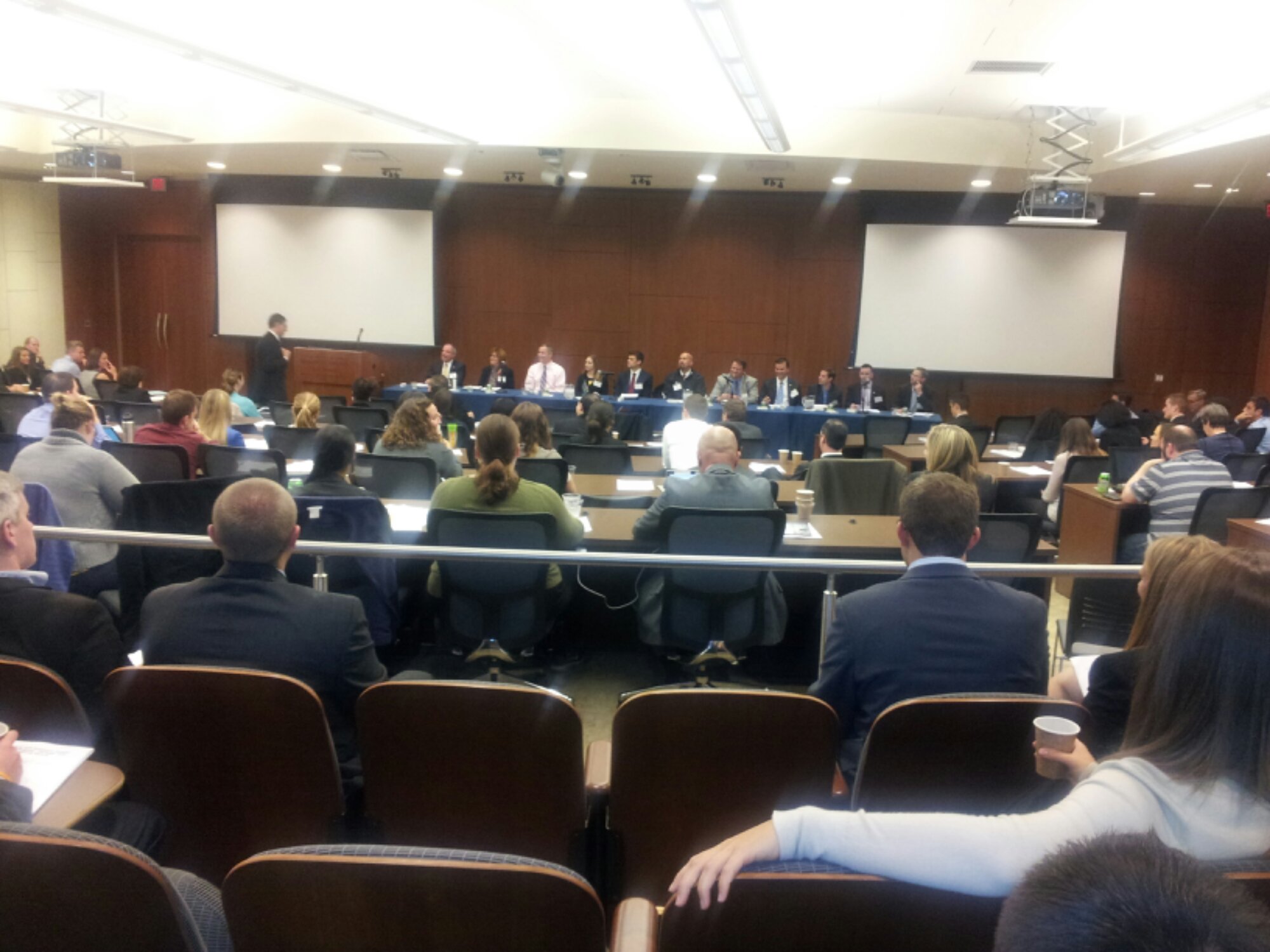
National Sports Law Institute Sports Law Conference at Marquette Law School

Image

image
This may be the best sports law conference in the US.
Information on the conference can be found here