Prime Time Sports Conference: Fifth Update

I am at the Prime TIme Sports Law and Marketing Conference in Toronto. I will blog during this two period on high lights of the conference.

First Panel, Doug Boies, Indianapolis Speedway, Tim Leiweke, Brian Burke, Calgary Flames, Chris Lencheski, Comcast, Bruce Popko, Buffalo Bills.

What is consistent here is the need to constantly improve the inpark experience to make attendance relevant in the age of HD tv.

They all speak of media as the driver and that is the way they intend to get to young users.

All speakers are now dealing with the need to deal properly with the media. Essentially, media people need to be tolerated and also need to “remember some papers are only of value to people who own a puppy or a parakeet.”

Last major topic was on marketing and the advice is to market something else than winning, as winning will not happen enough. Focus on fun etc.

Now Gary Bettman is being interviewed. Says league recovered very fast and after lockout.

Teams need deal with real problems and make changes even if that means short term labor pain. Now they have a good system and ten year deal. Nothing works unless you have the right system.

Revenues will grow by $1,000,000,000 òver the next three years.

The program I participated in was on drug use. I said that drug use can be traced to 776BC in Greece where herbs and other stimulants were used along with eating gonads and hearts. I then went through the years with the evolution of doping. From the Greeks to Lance Armstrong

Steve Fehr said baseball player’s association did not catch on to the extent and danger of steroids until late and should have embraced it sooner.

Sara Moore on marketing the Grey Cup/ Says need to go to the grass roots to get people to play football. continuum of interest from non-fans to most rabid fans.

Now we move to advanced analytics moderated by Dr. Dana Sinclair who says data used today is ridiculous:
From the speakers, Kevin Abrams, Kevin Chevaldayoff, Patrick Morris, Dave Nonis, Alex Rucker. Abrams says scouts make most decisions in football. Intelligence counts and they do research into character. Cheveldayoiff Hockey still split on analytics, still in infancy. Says he looks at data and finds new things that help analyze. Looks for unseen factors. This guy may get it!! Says no one variable looks for multipletrends.

Morris says NHL is really into data. Corsi, Fenwick, names? Time on ice. This is an agent, I would think.

Dave Nonis GM Maple Leaf. You stats, not sure they are valid. But thinks something there of value. Gets stuff regularly. Gets poluted stats. Not generated by person who uses standard to determine blocked shot for example. hard stats are time on ice shots etc. Still prefers to see player.

Alex Rucker cameras allows for total analysis of everthing that happens on the court. Analytics only one part of the story. Character, intellect, mental toughness cited as important, if not most important feature. How do you analyze that?

Anton Thun says that analytics is only codification of scouting data. Same thing, he says.

Jack Morris Should be in the Hall Of Fame

Jack Morris was a great, dominate, and very competitive pitcher. He won 254 games and lost 186. He pitched 3,824 innings and struck out 2478. Furthermore, Morris pitched at a time when he expected to pitch the whole game, therefore he had to manage his performance to allow him to do this. If he pitched today, he would only pitch six innings and his WHIP would be better.

Murray Chass has a very good discussion of this issue here that you should read.
I admired Morris for his competitiveness as shown in his ten inning victory in game seven in 1991. It was the best pitched game I have seen and it shows that he was a true Alpha player, who leads teams and beats others when it has to be done. He is deserving of this recognition.

Minneapolis: Clearing Skies at 5:00pm

image

This photo shows clearing skies in Minneapolis after a cloudy week. Clearing usually means colder, so hang on folks.

Why Orchestras and Football Teams Are In the Same Business

Professional orchestras and sports teams are remarkably similar in their business operations and in labor relations. Orchestra management and sports management are in the same business, the difference being whether the players are holding a bat or a bassoon. In both industries,management scouts and hires talented players to perform difficult feats in such a compelling way that people pay for tickets to their events and fill concert halls and stadiums. In both industries,labor problems have caused enormous disruptions such as the one that has closed Orchestra Hall in Minneapolis for the last year. Just as the first baseball union formed the Players’ League and tried to play its own schedule, the musicians of the Minnesota Orchestra have formed the Minnesota Orchestra Musicians to produce their own concerts. The “Players’ League” failed as the baseball players lacked capital and had the tendency to overpay themselves. The Minnesota Orchestra Musicians are following a similar path now and will learn about orchestra management’s importance.

Professional athletes and musicians start their careers early in life, either playing in Little League or in a school band. They both practice their skills the prescribed 10,000 hours to perfect the art.As they improve, they begin to stand out from their peers and are given privileges, receive adulation, and develop commensurate egos. Both players compete in countless try outs, are recruited, and attend special schools, The Eastman School and Julliard are the same as LSU and Alabama in this respect. Star at either and play later as a professional.

Players in both “sports” survive a rigorous elimination process where they are promoted over peers and then find themselves in the “Big Leagues.” They note the full audiences and regale in the applause. They understand that all of this is due to their unique talent, especially when they are the featured soloist playing Bach’s “Toccata & Fugue,” or quarterback starring in the Super Bowl. The audience is not cheering the Board of Directors are they? This sense of self leads to monumental labor conflicts which is the history of professional sports. The National Football League has adopted a salary cap/revenue sharing plan that lends itself to the orchestra setting, and should be applied to the Minnesota Orchestra.

The NFL system is based on a revenue metric and a percentage of revenue to be paid to the players. For the orchestra, the union and management would agree on the revenue attributable to the musicians–from tickets sold for orchestra events, sales of DVD’s and other media, to t-shirts,and then agree on the percentage payable to the players, and different percentages can be paid from tickets and DVD’s. The allocation between the players can also be part of the agreement.Most of the elements of this plan are already in place. It is a matter of agreeing to the concept and then sitting down and working out the details.

I have been involved in labor relations for decades and recognize that this is the time for bold action by the orchestra board. Such bold action by the NFL created the balanced plan that benefits owners, players, and fans of that sport. By adopting such a plan, the Orchestra can look forward to long term labor peace and we concert goers can enjoy the wonderful music they create.

Minneapolis Mayoral Election; Vote For Your Favorite Three

Today is election day for Mayor of Minneapolis and there are thirty-five candidates and the system to be used to elect one of them is called Ranked Choice. This means you are asked to vote for your top three candidates, and that is why there are thirty-five candidates. Of course, a very small fee and simple candidate registration system also helped.  For more information from the newspaper look here.

Ranked Choice voting works like this. You vote for your top three candidates, or just one, if you wish. Then when no candidate has 50% plus one of the vote, the votes for the least popular candidate are thrown out and the second place candidate is advanced and the total taken again. That means if you vote for Alpha as your first choice, and Alpha is the least vote getter, then your vote for Beta in second place becomes your first choice. This process repeats until there is one candidate with the 50% plus one. This process is all computer generated so we will see who wins.

Remember that this is the state that prides itself on no voter fraud but where in 2008 a candidate’s supporters found 300 ballots in the trunk of a car, and then found a couple hundred in a living room and kept finding lost ballots until their candidate won. No one ever asked, like a judge, just how these ballots got in the car. How wonderful that all of those lost ballots were found so the people who cast those ballots would not be disenfranchished! This is the state where the Secretary of State just put up a web based voter registration system. This is so people in Uzbekistan can register to vote in Minnesota. How terrific! Remember, making a person show indentification before registration or voting is merely an effort to supress the vote!! No doubt, limiting the vote to residents and citizens does supress the vote.

The Best Autumn Color is Here

image

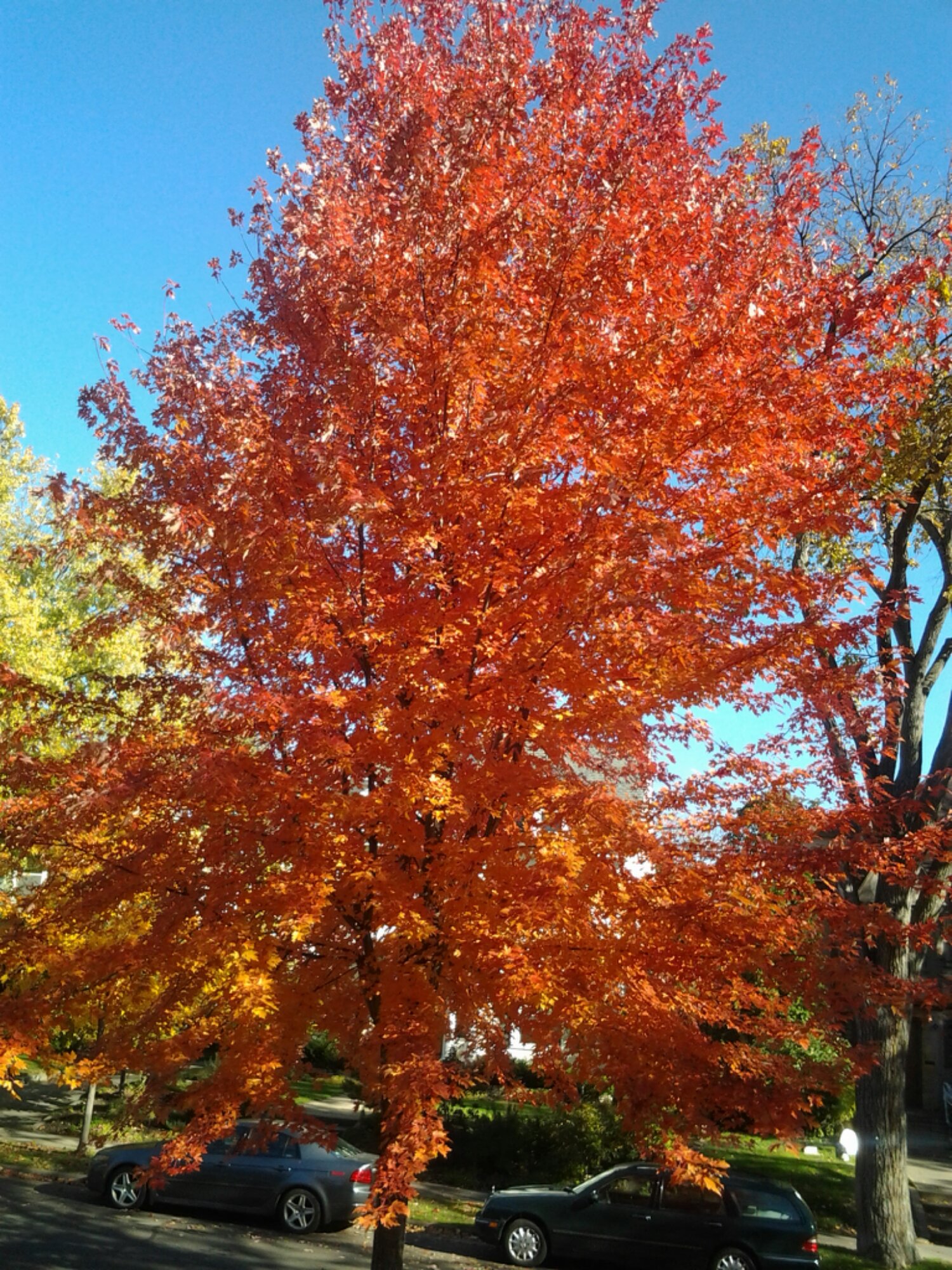
This tree in front of my house is an Autumn Blaze Maple. It is a combination of the better features of the silver and red maples and was named Urban Tree of the Year in 2003.   The neighborhood was hit hard by Dutch Elm disease over the last decades and has lost a lot of the huge elms that formed a canopy over the streets.  Now a mix of trees, some reaching maturity, form a mosaic of autumn color to contrast with the uni-colored elm coloration which is mainly yellow.  The move to mixed diciduous trees has some benefits, but I do miss the cathedral like canopy of 100 year old elms.
Unfortunately, many areas planted Ash trees that are now being attacked by Emerald Ash Borer. That did not occur in my Lowry Hill neighborhood in Minneapolis, thankfully. Here is a photo of the street with the Autumn Blaze in the middle.

image

The snow will fly soon, and an entirely different aesthetic will occur that is beautiful in its own way.

Bart Giamatti’s “The Green Fields of the Mind,” After a Fenway Victory (Link Fixed)

Former Yale President and Baseball Commissioner A. Bartlett Giamatti was a baseball fan. His writings reflect that and in this excerpted piece, you can get a feel for the man’s baseball passion.

                                                                 “The Green Fields of the Mind “

It breaks your heart. It is designed to break your heart. The game begins in the spring, when everything else begins again, and it blossoms in the summer, filling the afternoons and evenings, and then as soon as the chill rains come, it stops and leaves you to face the fall alone. You count on it, rely on it to buffer the passage of time, to keep the memory of sunshine and high skies alive, and then just when the days are all twilight, when you need it most, it stops. Today, October 2, a Sunday of rain and broken branches and leaf-clogged drains and slick streets, it stopped, and summer was gone.

Somehow, the summer seemed to slip by faster this time. Maybe it wasn’t this summer, but all the summers that, in this my fortieth summer, slipped by so fast. There comes a time when every summer will have something of autumn about it. Whatever the reason, it seemed to me that I was investing more and more in baseball, making the game do more of the work that keeps time fat and slow and lazy. I was counting on the game’s deep patterns, three strikes, three outs, three times three innings, and its deepest impulse, to go out and back, to leave and to return home, to set the order of the day and to organize the daylight. I wrote a few things this last summer, this summer that did not last, nothing grand but some things, and yet that work was just camouflage. The real activity was done with the radio–not the all-seeing, all-falsifying television–and was the playing of the game in the only place it will last, the enclosed green field of the mind. There, in that warm, bright place, what the old poet called Mutability does not so quickly come. . . .(The entire article can be found “Here.  I had dinner with Giamatti before he became Commissioner and he told me about his writing. When he was Commissioner,  he said “No one would publish this stuff, (including Yale University)  until I became Commissioner and now everyone wants to.”

During dinner, I recall we discussed baseball and our shared favorite song, “Amazing Grace” and replayed our shared favorite movie, “The Third Man.”  Dessert was shared chocolate fondue. It was a wonderful evening. 

This is a maple in front of my house. The Orange color is a combination of silver maple and blaze maple genetics.

Image

image

Baseball; The Long Season Ends, Not With a Bang But a Whimper

The Boston Red Sox won the sixth and final World Series game of 2013 when they defeated the St. Louis Cardinals 6-1. It seemed that the Cardinals, who out hit the Red Sox 9-8, just couldn’t win this important game as the key moments all belonged to the Red Sox. The prime moment came in the third inning, when, after Dustin Pedroia singled, Series MVP, David Ortiz was walked intentionally. He batted .688 for the Series. With two on and two out, Michael Wacha hit Jonny Gomes, loading the bases, setting the stage for the big hit. Shane Victorino then cleared the bases with a hit off the wall in left. The key element here was that Wacha hit Gomes. This indicated that his control was off, he didn’t have the command that had allowed him to pitch superbly in post-season games resulting in a 4-0 record. That he was not the master this night was evident earlier as well as he allowed runners in the first two innings. This lack of command then produced the big hit when he fell behind Victorino 2-0. Victorino guessed fast ball and got it and it was up in the zone and inside, but not far enough. His hit off the Green Monster, as the left field fence in known in Fenway Park, was the game. A homerun by slumping Stephen Drew and RBI singles by Mike Napoli and Victorino, again, in the fourth ended Red Sox scoring, but it was enough.

The Cardinals never got it going in this game, or, for that matter, the last three. Their win in game three on the rarely used obstruction call (See explanation here) was their high point. After that, they were flat and lost. There is always hope in Baseball where there is no clock to end the game and a team always has a chance to continue play. Here, the final inning went in few pitches and two fly ball outs and a final strike out of Matt Carpenter on a 2-2 pitch by Koji Uehara, the Red Sox closer, ended it, not with a bang, but a whimper.

The long season that begins in the first week of April and ends the last week of October, is now over. I wrote many posts on this season that are available in the archives and can only wait for 2014. A year ago, the Red Sox finished last and now join the 1991 Minnesota Twins as the two teams who have gone from worst to first in one year. I have little hope that will happen soon. Go Cubs? Maybe not this year.

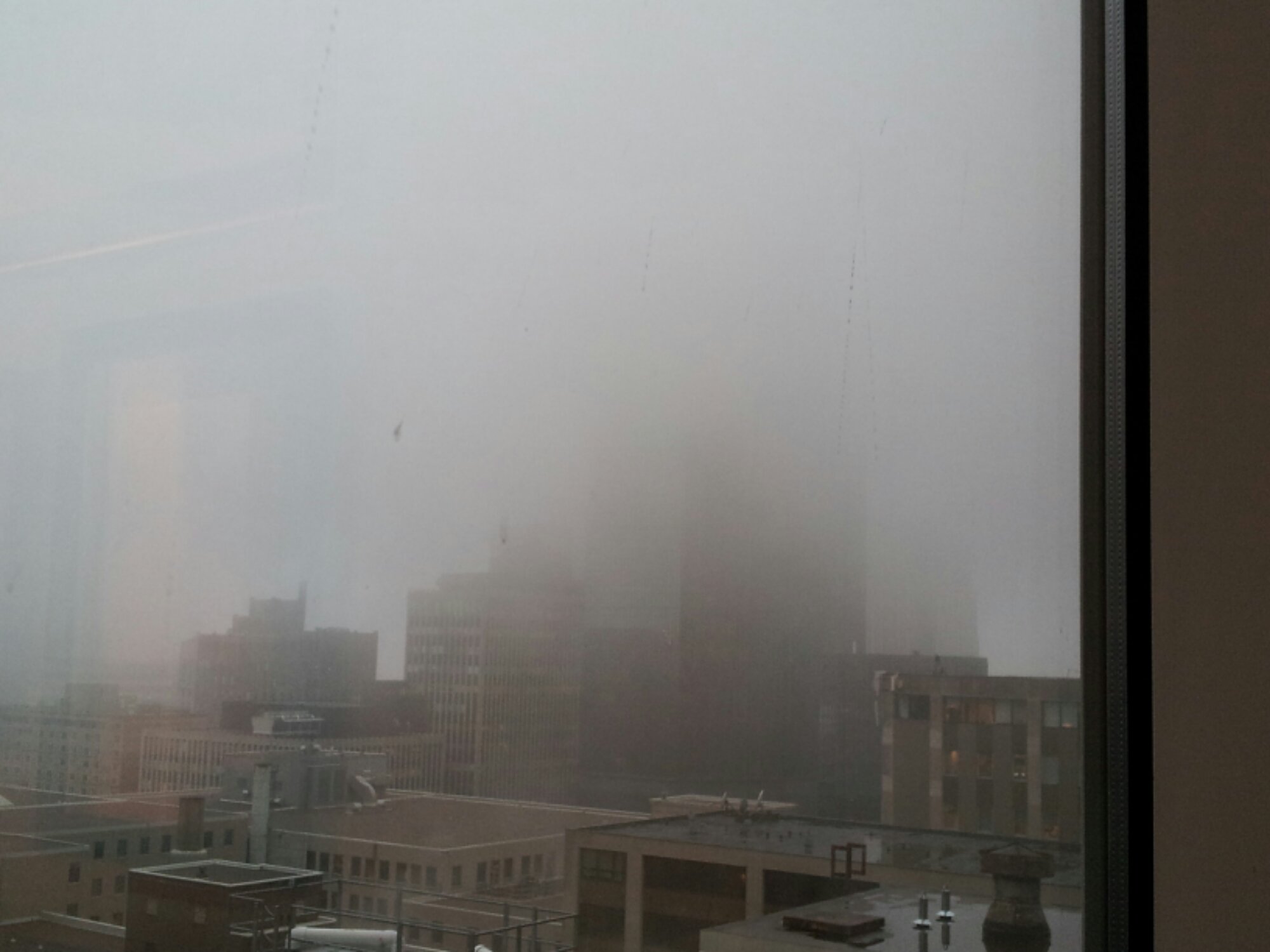
IDS shrouded in fog. Minneapolis at 5:00pm.

Image

image