Learned Comment on the Middlebury Mess

Sign the Statement: Truth Seeking, Democracy, and Freedom of Thought and Expression – A Statement by Robert P. George and Cornel West

March 14, 2017

The pursuit of knowledge and the maintenance of a free and democratic society require the cultivation and practice of the virtues of intellectual humility, openness of mind, and, above all, love of truth. These virtues will manifest themselves and be strengthened by one’s willingness to listen attentively and respectfully to intelligent people who challenge one’s beliefs and who represent causes one disagrees with and points of view one does not share.

That’s why all of us should seek respectfully to engage with people who challenge our views. And we should oppose efforts to silence those with whom we disagree—especially on college and university campuses. As John Stuart Mill taught, a recognition of the possibility that we may be in error is a good reason to listen to and honestly consider—and not merely to tolerate grudgingly—points of view that we do not share, and even perspectives that we find shocking or scandalous. What’s more, as Mill noted, even if one happens to be right about this or that disputed matter, seriously and respectfully engaging people who disagree will deepen one’s understanding of the truth and sharpen one’s ability to defend it.

None of us is infallible. Whether you are a person of the left, the right, or the center, there are reasonable people of goodwill who do not share your fundamental convictions. This does not mean that all opinions are equally valid or that all speakers are equally worth listening to. It certainly does not mean that there is no truth to be discovered. Nor does it mean that you are necessarily wrong. But they are not necessarily wrong either. So someone who has not fallen into the idolatry of worshiping his or her own opinions and loving them above truth itself will want to listen to people who see things differently in order to learn what considerations—evidence, reasons, arguments—led them to a place different from where one happens, at least for now, to find oneself.

All of us should be willing—even eager—to engage with anyone who is prepared to do business in the currency of truth-seeking discourse by offering reasons, marshaling evidence, and making arguments. The more important the subject under discussion, the more willing we should be to listen and engage—especially if the person with whom we are in conversation will challenge our deeply held—even our most cherished and identity-forming—beliefs.

It is all-too-common these days for people to try to immunize from criticism opinions that happen to be dominant in their particular communities. Sometimes this is done by questioning the motives and thus stigmatizing those who dissent from prevailing opinions; or by disrupting their presentations; or by demanding that they be excluded from campus or, if they have already been invited, disinvited. Sometimes students and faculty members turn their backs on speakers whose opinions they don’t like or simply walk out and refuse to listen to those whose convictions offend their values. Of course, the right to peacefully protest, including on campuses, is sacrosanct. But before exercising that right, each of us should ask: Might it not be better to listen respectfully and try to learn from a speaker with whom I disagree? Might it better serve the cause of truth-seeking to engage the speaker in frank civil discussion?

Our willingness to listen to and respectfully engage those with whom we disagree (especially about matters of profound importance) contributes vitally to the maintenance of a milieu in which people feel free to speak their minds, consider unpopular positions, and explore lines of argument that may undercut established ways of thinking. Such an ethos protects us against dogmatism and groupthink, both of which are toxic to the health of academic communities and to the functioning of democracies.

Robert P. George is McCormick Professor of Jurisprudence and Director of the James Madison Program in American Ideals and Institutions at Princeton University.

Cornel West is Professor of the Practice of Public Philosophy in the Divinity School and the Department of African and African- American Studies at Harvard University.

If you would like to join Professors George and West as a public signatory to this statement, please submit your name and title and affiliation (for identification purposes only) via email to jmadison@Princeton.edu(link
A Learned Response to the Middlebury Mess

Sign the Statement: Truth Seeking, Democracy, and Freedom of Thought and Expression – A Statement by Robert P. George and Cornel West

March 14, 2017

The pursuit of knowledge and the maintenance of a free and democratic society require the cultivation and practice of the virtues of intellectual humility, openness of mind, and, above all, love of truth. These virtues will manifest themselves and be strengthened by one’s willingness to listen attentively and respectfully to intelligent people who challenge one’s beliefs and who represent causes one disagrees with and points of view one does not share.

That’s why all of us should seek respectfully to engage with people who challenge our views. And we should oppose efforts to silence those with whom we disagree—especially on college and university campuses. As John Stuart Mill taught, a recognition of the possibility that we may be in error is a good reason to listen to and honestly consider—and not merely to tolerate grudgingly—points of view that we do not share, and even perspectives that we find shocking or scandalous. What’s more, as Mill noted, even if one happens to be right about this or that disputed matter, seriously and respectfully engaging people who disagree will deepen one’s understanding of the truth and sharpen one’s ability to defend it.

None of us is infallible. Whether you are a person of the left, the right, or the center, there are reasonable people of goodwill who do not share your fundamental convictions. This does not mean that all opinions are equally valid or that all speakers are equally worth listening to. It certainly does not mean that there is no truth to be discovered. Nor does it mean that you are necessarily wrong. But they are not necessarily wrong either. So someone who has not fallen into the idolatry of worshiping his or her own opinions and loving them above truth itself will want to listen to people who see things differently in order to learn what considerations—evidence, reasons, arguments—led them to a place different from where one happens, at least for now, to find oneself.

All of us should be willing—even eager—to engage with anyone who is prepared to do business in the currency of truth-seeking discourse by offering reasons, marshaling evidence, and making arguments. The more important the subject under discussion, the more willing we should be to listen and engage—especially if the person with whom we are in conversation will challenge our deeply held—even our most cherished and identity-forming—beliefs.

It is all-too-common these days for people to try to immunize from criticism opinions that happen to be dominant in their particular communities. Sometimes this is done by questioning the motives and thus stigmatizing those who dissent from prevailing opinions; or by disrupting their presentations; or by demanding that they be excluded from campus or, if they have already been invited, disinvited. Sometimes students and faculty members turn their backs on speakers whose opinions they don’t like or simply walk out and refuse to listen to those whose convictions offend their values. Of course, the right to peacefully protest, including on campuses, is sacrosanct. But before exercising that right, each of us should ask: Might it not be better to listen respectfully and try to learn from a speaker with whom I disagree? Might it better serve the cause of truth-seeking to engage the speaker in frank civil discussion?

Our willingness to listen to and respectfully engage those with whom we disagree (especially about matters of profound importance) contributes vitally to the maintenance of a milieu in which people feel free to speak their minds, consider unpopular positions, and explore lines of argument that may undercut established ways of thinking. Such an ethos protects us against dogmatism and groupthink, both of which are toxic to the health of academic communities and to the functioning of democracies.

Robert P. George is McCormick Professor of Jurisprudence and Director of the James Madison Program in American Ideals and Institutions at Princeton University.

Cornel West is Professor of the Practice of Public Philosophy in the Divinity School and the Department of African and African- American Studies at Harvard University.

If you would like to join Professors George and West as a public signatory to this statement, please submit your name and title and affiliation (for identification purposes only) via email to jmadison@Princeton.edu(link

The NFL’s Prescription Drug Problem

I encountered a friend and famous Viking defensive lineman one Sunday morning before a game. He was not walking well. He said, “When it hurts Sunday from last Sunday, it’s time to think about doing something else!!” 

Football is a violent game and pain is the constant.  Medication is required and its use is problematic, as the following article claims. 

National Football League teams violated federal laws governing prescription drugs, disregarded guidance from the Drug Enforcement Administration on how to store, track, transport and distribute controlled substances, and plied their players with powerful painkillers and anti-inflammatories each season, according to sealed court documents contained in a federal lawsuit filed by former players.

The sealed material, which was reviewed by The Washington Post, provides a rare look into the league’s relationship with drugs and how team doctors manage the pain inherent in a bruising sport to keep players on the field.

Federal law lays out strict guidelines for how teams can handle and dispense prescription drugs. The sealed court filing, which includes testimony and documents by team and league medical personnel, describes multiple instances in which team and league officials were made aware of abuses, record-keeping problems and even violations of federal law and were either slow in responding or failed to comply.

The filing, which was prepared by lawyers for the players suing the league, asserts that “every doctor deposed so far … has testified that they violated one or more” federal drug laws and regulations “while serving in their capacity as a team doctor.” Anthony Yates, the Pittsburgh Steelers’ team doctor and past president of the NFL Physicians Society, testified in a deposition that “a majority of clubs as of 2010 had trainers controlling and handling prescription medications and controlled substances when they should not have,” the filing states.

NFL spokesman Brian McCarthy said the allegations contained in the court filing “are meritless and the league and its clubs will continue to vigorously defend these claims.

“The NFL clubs and their medical staffs are all in compliance with the Controlled Substances Act,” McCarthy said in an email. “… The NFL clubs and their medical staffs continue to put the health and safety of our players first, providing all NFL players with the highest quality medical care. Any claim or suggestion to the contrary is simply wrong.”

The details and communications were unearthed by lawyers representing more than 1,800 former professional football players who are suing the league in U.S. District Court for Northern California, claiming they suffer long-term organ and joint damage, among other maladies, as a result of improper and deceptive drug distribution practices by NFL teams.

The material was collected by the players’ attorneys as part of the discovery process in the case. The attorneys redacted large portions of the 127-page complaint because both parties had agreed to do so under a court-approved protective order, sealing it from public view. The Post was able to review the redacted information because of an apparent technical error in the filing process but not some of the supporting exhibits and documents.

The filing solely reflects the ex-players’ claims against the NFL’s 32 teams, presenting their legal arguments and evidence to the court.

Democrats Asked Russia For Election Help.

The Theory that the Russians assisted Donald Trump in his election is the most absurd political theory I’ve heard recently. They clearly hoped for and expected a Clinton victory and were looking forward to dominating her.  They were simply trying to soften her up. the Russians are very nervous about Trump, who they expected to lose as they read the same polls the mainstream media was reading, are now trying to adjust to having a president they can’t push around. 

Interference in elections is nothing new. Obama actually sent a team to Isreal to try to defeat Netanyahu in his re-election campaign and Ted Kennedy tried to make a deal with Andropov in an effort to defeat Reagan. Read about that below.

From John Hinderaker at Poserlineblog.com

CONSPIRE WITH RUSSIA TO SWING PRESIDENTIAL ELECTION? IT’S BEEN DONE

The Democrats’ allegations against Jeff Sessions, one of the most upright men in Washington, are ludicrous. I don’t understand how anyone can think they amount to anything. But if the Democrats want to talk about collusion with the Russians, by all means let’s have that conversation.

Chris Adams takes us on a walk down memory lane. In 1983, Ted Kennedy–the “liberal lion of the Senate”–tried to enlist the Soviet Union, our most bitter enemy, in the Democrats’ effort to defeat President Ronald Reagan’s re-election.

Yes, a United States senator really did collude with the Russians to influence the outcome of a presidential election. His name was Ted Kennedy.

While Sen. Al Franken (D-Ringling Bros.) and other Democrats have the vapors over a truthful, complete, and correct answer Attorney General Jeff Sessions gave in his confirmation hearing, it’s worth remembering the reprehensible behavior of Senator Ted Kennedy in 198[3].
***
To recap, from Forbes:

Picking his way through the Soviet archives that Boris Yeltsin had just thrown open, in 1991 Tim Sebastian, a reporter for the London Times, came across an arresting memorandum. Composed in 1983 by Victor Chebrikov, the top man at the KGB, the memorandum was addressed to Yuri Andropov, the top man in the entire USSR. The subject: Sen. Edward Kennedy.

Kennedy’s message was simple. He proposed an unabashed quid pro quo. Kennedy would lend Andropov a hand in dealing with President Reagan. In return, the Soviet leader would lend the Democratic Party a hand in challenging Reagan in the 1984 presidential election. “The only real potential threats to Reagan are problems of war and peace and Soviet-American relations,” the memorandum stated. “These issues, according to the senator, will without a doubt become the most important of the election campaign.”

Kennedy made Andropov a couple of specific offers.

Among the promises Kennedy made the Soviets was he that would ensure that the television networks gave the Soviet leader primetime slots to speak directly to the American people, thus undermining Reagan’s framing of the sinister nature of the USSR. Even then, the Democrats had the power to collude with the legacy media. Kennedy also promised to help Andropov penetrate the American message with his Soviet agitprop.

That’s right, folks. Even 30 years ago, Democrat senators were colluding with America’s enemies to bring down Republicans.

The Gorsuch Comments; Checkers or Chess?

Neil Gorsuch made comments to Senator Blumenthal that were critical of Donald Trump.

For a Supreme Court nominee to do such a thing before his nomination hearing much less the Senate vote raises questions. Is Gorsuch playing checkers, whereby we can assume he just made a comment he shouldn’t have made or is he playing chess, whereby he made a comment that will give the impression that he is not under Trump’s thumb and lure Democrats into voting for him so that he gets the 60 votes to put him on the court? Read more about it below, but for me, it’s the opening gambit of a very smart man. Pawn to G5.

U.S. Supreme Court nomineeNeil Gorsuch told a Democratic senator he foundDonald Trump’s comments “disheartening” and “demoralizing” when the president criticized the judiciary over a federal court order that blocked his immigration ban.

SenatorRichard Blumenthal of Connecticut told reporters about Gorsuch’s comments after meeting privately Wednesday with Trump’s first U.S. high court nominee.Ron Bonjean, a spokesman aiding Gorsuch in the confirmation process, confirmed Blumenthal’s account of their conversation in an e-mail and said Gorsuch “used the words disheartening and demoralizing.”

More from Bloomberg.com: Trump on Immigration Power: I Can Do Whatever I Want

“He certainly expressed to me that he is disheartened by demoralizing, abhorrent comments made by President Trump about the judiciary,” Blumenthal said outside his Senate office. “But I will be asking for more specific and forthcoming comments to those kinds of questions before I determine how I will vote.”

Trump on Feb. 4 criticized a federal judge who blocked his travel ban as a “so-called judge.” On Wednesday, the president argued that his power to limit immigration shouldn’t be challenged in courts.

“The courts seem to be so political, and it would be so great for our justice system if they would be able to read a statement and do what’s right, and that has got to do with the security of our country, which is so important,” Trump told a conference of police chiefs and sheriffs in Washington.

More from Bloomberg.com: China Woos Ivanka, Jared Kushner to Smooth Ties With Trump

QuickTake on Trump’s refugee ban and the legal battle over it

Gorsuch’s strong criticism of Trump could help convince skeptical Democrats, angry over the president’s reaction to the travel-ban ruling, to give Gorsuch more serious consideration. The exchange between Gorsuch and Blumenthal, who serves on the Judiciary panel that will hold the judge’s confirmation hearing, comes after demands from Senate Democrats that Gorsuch demonstrate his willingness to be an independent jurist and a check on potential abuses of power from the executive branch.

Blumenthal had told reporters Tuesday that he planned to call on Gorsuch to repudiate Trump’s statements about the judiciary.

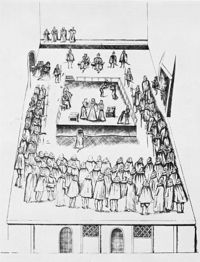
The Execution of Mary, Queen of Scots

Mary of Scotland had been Queen of France for a year. She also had a valid claim tp the English Crown, now worn by her cousin Elizabeth I. She was accused of treason and beheaded by Elizabeth,  who then left the English crown to Mary’s son James, who was James VI of Scotland, but James I of England.  He was King James of Bible fame. It is a great story.  

A Death:

Shrewsbury: ” … Madam you must die, you must die!…”

The executioner held up the severed head of the Queen of Scots for all to see — but horror as the hair separated from the head, and the head dropped to the floor. There was a stunned silence from the spectators — the Queen, once considered the most beautiful woman of her time, had lost her hair and vanity dictated the wearing of a wig.

The Dean of Peterborough stood over the corpse of the dead Queen and uttered the words all longed to hear: “So perish all the Queen’s enemies”.

The body of the dead Queen was stripped, in readiness to be received by the embalmers — but the dead Queen’s corpse held yet another surprise. Concealed within her skirts was a small terrier, which positioned itself betwixt the severed head and the body, and nothing could move it. It alone remained loyal to the Queen.

But the indignity of the execution of the Queen of Scots was not over. The execution block, her clothing and any other object which could be considered a relic was burned at Fotheringhay, which was in lock down.

It was not until approximately four in the afternoon that the Queen of Scots’ body was prepared for burial — but not the burial one would associate with a monarch. No — the Queen’s lead coffin was walled up within the precincts of Fotheringhay Castle. It was not until her son succeeded as James I of England, that the Queen was accorded a suitable and more Christian burial at Westminster Abbey.

A Life:

Mary was born 8 December 1542 at Linlithgow, Scotland, the daughter of James V of Scotland (d. 1542) and Mary of Guise (d. 1560). From the day of her birth, Mary was betrothed to the future Edward VI of England — the vetoing of this marriage led to war with England.

In the ensuing conflict, the Scots were defeated at Pinkie (10 September 1547) by forces of the Duke of Somerset. A French alliance was decided upon. Mary was sent to the French court aged 5 (1548), where she received a Catholic upbringing under her Guise uncles. Mary married the Dauphin Francis at Paris, France (24 April 1558). Her husband succeeded to the French throne as King Francis II (1559).

Mary became Queen of France but shortly after, Francis died (1560/1561). Mary was returned to Scotland (1561), and upon her arrival promptly proclaimed herself rightful Queen of England as the granddaughter of Henry VIII’s sister, Margaret Tudor.

However, during her absence, things had changed in Scotland, and Mary had to adapt to the anti-monarchical, anti-Catholic, anti-French elements that now dominated Scotland. Then Mary embarked upon an ill-considered marriage to her cousin Henry Stuart, Lord Darnley (29 July 1565) at Edinburgh, Scotland. Mary soon gave birth to a son, James VI (of Scotland) & I (of England) (1566).

The following year Mary was caught up in the scandal surrounding the murders of her Secretary David Riccio and her husband, Darnley (1567). From then on, Mary made mistake upon mistake. Soon after both deaths, Mary made a scandalous third marriage to James Hepburn, 4th Earl Bothwell (1567), who just happened to have been recently acquitted of Darnley’s murder. Mary claimed that this marriage was made under duress — but none were convinced. There was an immediate uprising of Scottish lords which resulted in military defeat for Mary at Carberry Hill and Langside (1568).

Mary fled Scotland for England and threw herself on the mercy of Elizabeth I, who kept her imprisoned in various strongholds. Following numerous intrigues to rescue her and place her on the throne of England, Mary was placed on trial (Oct. 1586). She was found guilty of treason and sentenced to death (25 October 1586).

After delaying for as long as possible, Elizabeth reluctantly signed Mary’s death warrant (1 February 1587) and Mary was executed at Fotheringhay (8 February 1587).

A Question of Legality:

Was the execution of a monarch of one country by a monarch of another lawful?

Mary was initially brought to trial under the English Act of Association (1585) — which in the eyes of the English made Mary just as guilty as those who conspired against the Queen of England, either with or without her knowledge. Guilt by association — a phrase I am sure we have all heard of.

Mary herself said: ” … as Queen and Sovereign, I am aware of no fault or offence for which I have to render account to anyone …”

In fact, just how was it legal for a Queen of a foreign country to be tried for treason by a Queen whose subject she was not; in fact, how could one then execute this foreign sovereign?

The sovereignty of any monarch, at this period in time, was taken with all solemnity. Elizabeth I herself was fully aware of the implications — if Mary could be treated and punished like an ordinary subject, then what could Elizabeth herself expect should she venture beyond the English Channel? In fact, Mary could only be judged by her peers — and to this end, only Elizabeth filled this position — not the privy councilors or nobility.

The English jurists pondered over this question — if Mary committed treason, she should have been expelled from English soil. But in the end, the legal minds of England came up with a suitable solution. King Henry VIII claimed suzerainty over Scotland; thus, Mary was a subject of the English Queen and could be tried (and executed) for treason under English law.

As author Antonia Fraser wrote: “In the case of the trial of Mary Queen of Scots the traditional blindfold across the eyes of Justice was ruthlessly torn aside by English commissioners so that the desired verdict might be reached.”

The Day Buddy Holly Died

The Day the Music Died

fIFQFETZHKXUM
Michael Ochs Archives / Corbis

Buddy Holly and the Crickets perform on The Ed Sullivan Show on January 26, 1958 in New York City, New York.

When Elvis Presley died, 25,000 people gathered outside Graceland in the sweltering Memphis heat. John Lennon’s murder drew millions of people to Central Park for a silent vigil. But when Buddy Holly’s plane went down in an Iowa cornfield at a little past 1 a.m. on Feb. 3, 1959, there was nobody waiting for him among those swirling snowdrifts. The Lubbock, Texas singer never had a vigil. His home did not become a pilgrimage site and his family never held a memorial service for his fans. Yet with each passing decade, the myth of Buddy Holly has grown by substantial degrees. (See rare photos of Buddy Holly.)

If you go by the numbers, Buddy Holly’s career — which lasted a year and a half with only one number one single — hardly seems the stuff of legend. He only accepted top billing on the 24-day, 24-town “Winter Dance Party” tour alongside the Big Bopper (of “Chantilly Lace” fame) and Richie Valens (“La Bamba”) as a way to dig himself out of bankruptcy. And yet his influence on early rock ‘n’ roll is almost unmatched. Holly was barely out of high school when he opened for Elvis Presley in 1955. He popularized the two guitar, one bass, one drum lineup that so many acts (the Beatles, the Kinks, Talking Heads, Weezer) would later adopt. When a self-conscious Roy Orbison saw Holly’s black rimmed glasses and slim jim ties, he decided not to let his homely, face-for-radio looks hinder his singing career. (For a while, John Lennon even adopted the style). Holly wrote his own material and used his signature pitch-changing hiccup to move seamlessly between country, R&B and rockabilly. When he died, he was only 22.

On February 2, 1959, Holly and his tourmates were on the eleventh night of their Winter Dance Party tour through the snow-covered Midwest. It was a Monday — a school night — but 1,100 teenagers crammed into Clear Lake, Iowa’s Surf Ballroom for two sold out shows. They wore blue jeans and saddle shoes and screamed for 17-year-old Richie Valens, whose single “Donna” was about to go gold. Between sets, Holly solicited people to join him on the charter airplane he’d hired to fly to the next show in Moorhead, Minnesota. The musicians had been traveling by bus for over a week and it had already broken down once. They were tired, they hadn’t been paid yet and all of their clothes were dirty. With the airplane, Holly could arrive early, do everyone’s laundry and catch up on some rest.

A 21-year-old pilot named Roger Peterson had agreed to take the singer to Fargo, North Dakota — the closest airport to Moorehead. A snowstorm was on its way and the young pilot was fatigued from a 17-hour workday, but he agreed to fly the rock star to his next gig because, hey, he would be flying Buddy Holly. The second show ended at midnight. The musicians packed up their instruments and finalized the flight arrangements. Holly’s bass player, Waylon Jennings, was scheduled to fly on the plane but gave his seat to the Big Bopper, who was suffering from a cold. Holly’s guitarist Tommy Allsup agreed to flip a coin with Richie Valens for the remaining seat. Valens won. The three musicians boarded the red and white single-engine Beech Bonanza around 12:30 on Feb. 3. Fans flocked to the tarmac, waving and crying and asking for autographs. The musicians waved back and then climbed onto the plane. Snow blew across the runway but the sky was clear. Peterson received clearance from the control tower, taxied down the runway and took off. He was never told of two weather advisories that warned of an oncoming blizzard.

The plane stayed in the sky for only a few minutes; no one is quite sure what went wrong. The best guess is that Peterson flew directly into the blizzard, lost visual reference and accidentally flew down instead of up. The four-passenger plane plowed into a nearby cornfield at over 170 mph, flipping over on itself and tossing the passengers into the air. Their bodies landed yards away from the wreckage and stayed there for ten hours as snowdrifts formed around them. Because of the weather, nobody could reach the crash site until the morning.

In Texas, a neighbor told Holly’s mother to turn on the radio. When the news report came out, she screamed and collapsed. In Greenwich Village, Buddy Holly’s pregnant wife heard the news on television and suffered a miscarriage the following day, reportedly due to “psychological trauma.” In the months following the crash, authorities would adopt a policy against releasing victims’ names until after the families had been notified.

The Winter Dance Party tour continued, with Waylon Jennings singing Holly’s songs and other teen sensations, including 18-year-old Frankie Avalon, flown out to finish the tour. Holly’s body was shipped back home to Lubbock, Texas. His Baptist family never approved of his music and none of his songs were played at his funeral.

Then a strange thing happened. Holly’s last single, “It Doesn’t Matter Anymore,” had endured sluggish sales. The music industry had not yet discovered the commercial allure of untimely deaths, and record executives were shocked to see the song shoot up to number 13 on the charts.

Months went by, yet Holly’s albums continued to sell. Decca rushed out a greatest hits album, which would float on and off the Billboard charts for another seven years. Britain devoured Holly records faster than the record company could produce them. Demo tapes, B-sides, previously unreleased recording sessions — they all shot up the British charts and turned Holly into one of the forefathers of the British Invasion that would strike America five years later. Both John Lennon and George Harrison learned to play guitar in part by listening to Buddy Holly records. The first Rolling Stones’ single released in the U.S. was cover of Holly’s “Not Fade Away.” (See a video of Buddy Holly singing “Peggy Sue.”)

The first song memorializing the musicians — Eddie Cochran’s “Three Stars” — was recorded just one day after their deaths. But Don McLean’s 1971 single “American Pie” turned the plane crash into a metaphor for the moment when the United States lost its last shred of innocence. McLean envisioned that last Buddy Holly concert in Clear Lakes, Iowa: teenagers in pink carnations and pick-up trucks, dancing and falling in love and dancing some more. The snow fell silently outside as the country teetered on the brink of the 1960s; no one in the ballroom had any idea what would happen next.

Mexico’s Disastrous Treaty With The US

Below is a discussion of the Treaty of Guadalupe Hidalgo, signed today in 1848. Mexico ceded 500,000 square miles of territory, including California. That then was a dry, underpopulated region, however, the article fails to mention that gold was discovered near Sacramento in 1849. The rest, they say, is history.

War’s End

The Treaty of Guadalupe HidalgoTreaty of Guadalupe Hidalgo

by Richard Griswold del Castillo

The Treaty of Guadalupe Hidalgo ended the U.S.-Mexican War. Signed on 2 February 1848, it is the oldest treaty still in force between the United States and Mexico. As a result of the treaty, the United States acquired more than 500,000 square miles of valuable territory and emerged as a world power in the late nineteenth century.

Beyond territorial gains and losses, the treaty has been important in shaping the international and domestic histories of both Mexico and the United States. During the U.S.-Mexican War, U.S. leaders assumed an attitude of moral superiority in their negotiations of the treaty. They viewed the forcible incorporation of almost one-half of Mexico’s national territory as an event foreordained by providence, fulfilling Manifest Destiny to spread the benefits of U.S. democracy to the lesser peoples of the continent. Because of its military victory the United States virtually dictated the terms of settlement. The treaty established a pattern of political and military inequality between the two countries, and this lopsided relationship has stalked Mexican-U.S. relations ever since.

The treaty in draft form was brought to Mexico by Nicholas P. Trist, the U.S. peace commissioner, in the summer of 1847. In its basic form it called for the cession of Alta and Baja California and New Mexico, the right of transit across the Tehuantepec isthmus, and the Rio Grande as the southern border of Texas. In exchange the United States would pay up to $20 million to Mexico and assume up to $3 million in U.S. citizens’ claims against Mexico. In subsequent negotiations the demand for Baja California and the right of transit were dropped.

After the military campaign, which had resulted in U.S. occupation of most of Mexico’s major cities, the Mexican government agreed to meet with Trist to discuss peace terms. Just before negotiations were to begin, however, Trist received instructions from President James K. Polk ordering him to return to Washington, D.C. Trist, however, decided to stay on and meet with the Mexican representatives, even though he lacked official status.

Negotiations began in earnest in January 1848. The Mexican government, headed by the ad interim Mexican president Manuel de la Pena y Pena, quickly agreed to the boundary issues: Texas’s southern boundary would be the Rio Grande, the cession of Alta California would include the port of San Diego, and Mexico would give up its territory between Texas and California, with a boundary to be surveyed. Mexican peace commissioners Luis G. Cuevas, Bernardo Couto, and Miguel Atristain spent a good deal of time on various drafts of Articles VIII and IX, which dealt with the issues of property rights and U.S. citizenship for Mexican citizens in the newly ceded regions. The Mexican commissioners succeeded in amplifying the texts of the two articles. They also introduced Article XI, which gave the United States responsibility for controlling hostile Indian incursions originating on the U.S. side of the border. (Article XI proved to be a source of irritation between the two nations and was subsequently negated by the Gadsden Treaty of 1854.)

On his own initiative, Trist offered an indemnity of $15 million, judging that this would gain acceptance for the treaty among those who felt that the United States had already paid enough in “blood and treasure.”

Trist asking Mexico for peaceAfter reaching agreement on all these issues, Trist drew up an English-language draft of the treaty and Cuevas translated it into Spanish, preserving the idiom and thought rather than the literal meaning. Finally, on 2 February 1 1848, the Mexican representatives met Trist in the Villa of Guadalupe Hidalgo, across from the shrine of the patron saint of Mexico. They signed the treaty and then celebrated a mass together at the basilica.

Signing the treaty was only the beginning of the process; it still had to be ratified by the congresses of both the United States and Mexico. No one could foresee how the Polk administration would receive a treaty negotiated by an unofficial agent; nor could they know the twists and turns of the Mexican political scene for the next few months. In both the U.S. and Mexican governments there was opposition to the treaty. In the United States, the northern abolitionists opposed the annexation of Mexican territory. In the Mexican congress, a sizable minority was in favor of continuing the fight. Nevertheless both countries ratified the document. The signing of the Treaty of Guadalupe Hidalgo marked the end of a war and the beginning of a lengthy U.S. political debate over slavery in the acquired territories, as well as continued conflict with Mexico over boundaries.

The Treaty of Guadalupe Hidalgo looms larger in the history of Mexico than in that of the United States. Partly because of the loss of valuable territory, the treaty ensured that Mexico would remain an underdeveloped country well into the twentieth century. Mexican historians and politicians view this treaty as a bitter lesson in U.S. aggression. As a result of the humiliation of the war and the loss of more than half of the national territory, young Mexicans embraced a reform movement, headed by Benito Juarez, governor of Oaxaca, who had opposed the treaty. In the 1850s the reformers came to power in Mexico vowing to strengthen the country’s political system so that never again would they be victims of U.S. aggression. Benito Juarez’s La Reforma was the start of a political and economic modernization process that continues to this day in Mexico.

The Treaty of Guadalupe Hidalgo has had implications not only for relations between the two countries but also for international law. Interpretations of the provisions of the treaty have been important in disputes over international boundaries, water and mineral rights, and the civil and property rights of the descendants of the Mexicans in the ceded territories. Since 1848 there have been hundreds of court cases citing the Treaty of Guadalupe Hidalgo as a basis for land claims, but few Mexican claimants were successful in retaining their land.

Since 1848 Native Americans and Mexican Americans have struggled to achieve political and social equality within the United States, often citing the Treaty of Guadalupe Hidalgo as a document that promised civil and property rights. Although the treaty promised U.S. citizenship to former Mexican citizens, the Native Americans in the ceded territories, who in fact were Mexican citizens, were not given full U.S. citizenship until the 1930s. Former Mexican citizens were almost universally considered foreigners by the U.S. settlers who moved into the new territories. In the first half century after ratification of the Treaty of Guadalupe Hidalgo, hundreds of state, territorial, and federal legal bodies produced a complex tapestry of conflicting opinions and decisions bearing on the meaning of the treaty. The property rights seemingly guaranteed in Articles VIII and IX of the treaty (and in the Protocol of Queretaro) were not all they seemed. In. U.S. courts, the property rights of former Mexican citizens in California, New Mexico, and Texas proved to be fragile. Within a generation the Mexican-Americans became a disenfranchised, poverty-stricken minority.


The Russian Hacking Story in a Nutshell

In this digital age, government spend enormous amounts of money trying to penetrate the computer system of adversaries, like the US against Russia and China, and presumably our friends, as well. It would be nice to know what the British were thinking, after all. The Russians spent lots of money trying to “hack,” or penetrate, political party servers during the past campaign. It worked in part and failed in part and that is the story.

The Russians successfully penetrated the Democratic National Committee’s e-mail server by sending a Phish to its leader. He opened the email and disclosed his password, that, curiously because similar behavior by a child would be rare, was “password.” I don’t know if he used a capital “P,” but nevertheless!!

The Russians spent a lot of time trying to hack the Republican e-mail servers but, because the Republicans were serious about security, were never able to penetrate its servers.

Wikileaks got the Democrats stuff and it was hilarious, ripping each other, and making just outrageous comments that made them look stupid. This is not to say the Republicans are not stupid, and if the Republican servers were penetrated, I am sure similarly salacious e-mails would have been discovered and released to the enormous embarrassment of the Republicans.  That didn’t happen because the Republicans used solid security to avoid such embarrassment and the Democrats didn’t. Thre was no pro-Trump bias, as it is apparent the Russians were thinking Clinton would win up to the morning of November 9 and were simply toying with her.

This story is really that simple. A senior Democrat, some say John Podesta, used “password”  as his password. Oh, well, it proved to be the Key to the Kingdom. Now Clinton’s e-mail servers were also hacked, but that’s a different story, but also one based on a colossal lack of security in what is now a well known tale.


The Economics of the DH

Designated Hitters and the Economics of Baseball

TOM SZCZERBOWSKI/US PRESSWIREFrank Thomas

But let’s instead focus on another aspect of the DH rule: the practical effect of the rule on the game’s economic structure, and why the economic effects of the DH rule are precisely why we can neither get rid of it nor extend it to the National League.

A major league roster has 25 players, but the cost of those players is not evenly distributed, and neither is their impact on the team’s success. Most teams carry 11 or 12 pitchers, of whom five starters and perhaps three relievers will play critical roles. A National League roster has eight everyday players and a four- to six-man bench; in the American League, the DH means there’s one extra everyday player, generally at the expense of one bench job. Due in part to the expansion of bullpens, platooning is far rarer today than it was two decades ago, so there’s a wide gap in pay and playing time between true regulars and bench players. So, an NL team has about 16 crucial jobs, an AL team 17. But wait: A typical team will be able to fill about seven of those jobs with players who don’t have enough service time to demand high salaries. The reality is that adding another regular can take a team from nine to 10 jobs that truly require a major outlay of cash.

The numbers bear this out. The average AL payroll was $92.8 million from 2006 to 2010, while the average NL payroll was $80.1 million. If you look only at teams with winning records — working under the theory that those are the teams actually trying to spend enough money to compete and succeed — the disparity is even larger: The average winning AL team had a payroll of $108.4 million compared to $88.7 million in the NL. That’s a $20 million-a-year difference.

Is the DH rule to blame for this? It’s obviously not the only reason, but certainly it’s a contributing factor.

Over the same five-year period, the 14 American League teams employed something like a full-time DH in 57 out of 70 possible seasons. (“Full time” is defined here as 300 or more plate appearances with at least half the player’s games at DH.) The average salary of those players? $6.8 million. And that doesn’t include the cost of DHs who break down due to age or injury. Travis Hafner made more than $8 million in 2008, Ken Griffey $2.3 million in 2010, and neither made it to 300 plate appearances. Frank Thomas had a $12.5 million salary when he was with the Blue Jays in 2008, Pat Burrell was making $9 million from the Rays in 2010, Shea Hillenbrand $6 million from the Angels in 2007. All three were cut early in the year and were signed for a song by other teams.

The financial impact of the Designated Hitter rule also widens the gap between big- and small-market teams. Just compare the haves and have-nots: Over the same five seasons, the average AL team that finished .500 or worse had a payroll of $71.1 million, indistinguishable from the $72.0 million average in the NL but $37.3 million behind the winning teams, while the NL teams trailed the winners in their league by $17.6 million. Some of those American League teams kept their costs down by just giving up. Sure, a well-run small-market team can compete by filling roster spots with players who haven’t reached free agency yet and thus are paid below their market value. But the more roster spots there are to fill, the harder it is to use the farm system to keep up with the teams that are buying high-end veterans on the open market, especially the big sluggers who generally fill the ranks of DHs. The average age of the starting DHs in the AL over that period? 32.7 years old. Aside from Billy Butler on the 2007-08 Royals, no American League team employed a DH under the age of 25, and the only AL franchises to use a regular DH under age 29 were the Royals, Twins, Rays, and Blue Jays. And the DH gives roster flexibility to the biggest players in the free-agent market. The Yankees, for example, could move guys like Jason Giambi and Hideki Matsui there near the end of big contracts to make room for still more high-priced acquisitions.

The disparity in labor costs makes the National League more attractive to owners in the free-agency era. Two teams were added to the National League when Major League Baseball expanded in 1993, matching it with the American League. Then came the 1998 expansion and realignment. Tampa Bay and Arizona were added, and Commissioner Bud Selig managed to move the Brewers from the American League to the National League. The Rays and the Diamondbacks agreed that they could be shifted to another league without their consent, but when Selig floated a plan to realign them in 2001, the Rays expressed interest in going to the NL; the D-Backs, facing transfer to the AL, fought the plan. With another realignment scheme in the air this year, Astros owner Drayton McLane is singing the same tune.

Yet the same payroll considerations are why we are stuck with the DH. The MLB Players Association will fight tooth and nail to avoid losing those high-paying jobs, and, as was the case with steroid testing, owners seem to have higher priorities in the zero-sum negotiations with the union than fixing structural problems for the greater good of the game. In the case of the DH, the big-market AL teams have no financial incentive to reduce their competitive advantage, and the NL owners have no real stake in reducing the AL owners’ cost of doing business. Unless and until all the owners are willing to make financial concessions in other areas to bring an end to the DH rule in the AL, we’re stuck with it as is.

Dan McLaughlin is an attorney practicing in New York, and blogs on baseball, politics, pop culture and law at Baseball Crank. He also writes on other political and sports sites and was formerly a weekly columnist at bostonsportsguy.com.