http://www.clarkgriffithblog.com

Commentary on sports, current events, and politics

http://www.clarkgriffithblog.com

Hidden Figures is the Movie of the Year

Sima and I saw Hidden Figures recently and the house was sold out for several showings. It is the most inspirational movie of recent times. The story is compelling and involves the space program in the early 1960’s and three women’s critical contribution.

This is a “must see” movie that deals with a very important subject.

7.9/10

2,811

Rate This

Hidden Figures (2016)

PG | 2h 7min | Drama | 6 January 2017 (USA)
Hidden Figures Poster
Trailer

Thomas Sowell’s “Farewell.” This is important!

Farewell

Thomas Sowell
|
Posted: Dec 27, 2016 12:01 AM
 Even the best things come to an end. After enjoying a quarter of a century of writing this column for Creators Syndicate, I have decided to stop. Age 86 is well past the usual retirement age, so the question is not why I am quitting, but why I kept at it so long.It was very fulfilling to be able to share my thoughts on the events unfolding around us, and to receive feedback from readers across the country — even if it was impossible to answer them all.

Being old-fashioned, I liked to know what the facts were before writing. That required not only a lot of research, it also required keeping up with what was being said in the media.

During a stay in Yosemite National Park last May, taking photos with a couple of my buddies, there were four consecutive days without seeing a newspaper or a television news program — and it felt wonderful. With the political news being so awful this year, it felt especially wonderful.

This made me decide to spend less time following politics and more time on my photography, adding more pictures to my website (www.tsowell.com).

Looking back over the years, as old-timers are apt to do, I see huge changes, both for the better and for the worse.

In material things, there has been almost unbelievable progress. Most Americans did not have refrigerators back in 1930, when I was born. Television was little more than an experiment, and such things as air-conditioning or air travel were only for the very rich.

My own family did not have electricity or hot running water, in my early childhood, which was not unusual for blacks in the South in those days.

It is hard to convey to today’s generation the fear that the paralyzing disease of polio inspired, until vaccines put an abrupt end to its long reign of terror in the 1950s.

Most people living in officially defined poverty in the 21st century have things like cable television, microwave ovens and air-conditioning. Most Americans did not have such things, as late as the 1980s. People whom the intelligentsia continue to call the “have-nots” today have things that the “haves” did not have, just a generation ago.

In some other ways, however, there have been some serious retrogressions over the years. Politics, and especially citizens’ trust in their government, has gone way downhill.

Back in 1962, President John F. Kennedy, a man narrowly elected just two years earlier, came on television to tell the nation that he was taking us to the brink of nuclear war with the Soviet Union, because the Soviets had secretly built bases for nuclear missiles in Cuba, just 90 miles from America.

Most of us did not question what he did. He was President of the United States, and he knew things that the rest of us couldn’t know — and that was good enough for us. Fortunately, the Soviets backed down. But could any President today do anything like that and have the American people behind him?

Years of lying Presidents — Democrat Lyndon Johnson and Republican Richard Nixon, especially — destroyed not only their own credibility, but the credibility which the office itself once conferred. The loss of that credibility was a loss to the country, not just to the people holding that office in later years.

With all the advances of blacks over the years, nothing so brought home to me the social degeneration in black ghettoes like a visit to a Harlem high school some years ago.

When I looked out the window at the park across the street, I mentioned that, as a child, I used to walk my dog in that park. Looks of horror came over the students’ faces, at the thought of a kid going into the hell hole which that park had become in their time.

When I have mentioned sleeping out on a fire escape in Harlem during hot summer nights, before most people could afford air-conditioning, young people have looked at me like I was a man from Mars. But blacks and whites alike had been sleeping out on fire escapes in New York since the 19th century. They did not have to contend with gunshots flying around during the night.

We cannot return to the past, even if we wanted to, but let us hope that we can learn something from the past to make for a better present and future.

Goodbye and good luck to all.

George Washington Crossing the Delaware, 1851, by Emanuel Gottlieb Leutze.

Two Hundred Forty years ago, Christmas Eve, was a desperate time for America.  General Washington had lost the Battle of New York, and had been chased, humiliatingly, all the way across New Jersey, and into Pennsylvania.

Those were, as Thomas Paine‘s first “American Crisis” essay, dated December 23, 1776, declared “the times that try men’s souls”:

The summer soldier and the sunshine patriot will, in this crisis, shrink from the service of their country; but he that stands it now, deserves the love and thanks of man and woman. Tyranny, like hell, is not easily conquered; yet we have this consolation with us, that the harder the conflict, the more glorious the triumph.

The contrast with another Christmas Eve, seven years later, could hardly be greater.  General Washington, now the Commander-in-Chief of the victorious Continental Army, was in Annapolis, Maryland, where he surrendered his commission to the Continental Congress.  It is worthy of reflection.

Consider the situation in December, 1776.  The Army had failed to hold the center of the Union.  The British set up a series of forts across New Jersey to hold the turf for themselves, securing a line from New York City to the vicinity of Philadelphia, where the Continental Congress met.  Moreover, the Union army was close to dissolving.  Soldiers had signed up only for short terms, and many soldiers were looking forward to the end of their terms, some in late December, 1776, and most of the rest on the first of January, 1777.  According to Joseph Ellis, “more New York and New Jersey colonists were now signing up with the British than the American Army.”[1]

The British felt no sense of urgency.  By spring, the demoralized and disappearing Union army would be a rump, incapable of holding any ground.

Washington described the situation to his cousin, Lund Washington on December 17th:

We have prevented them from crossing; but how long we shall be able to do it God only knows, as they are still hovering about the river. And if every thing else fails, will wait till the 1st of January, when there will be no other men to oppose them but militia.

Washington’s soul passed the trial.  He rallied his men. On the 23rd, Benjamin Rush had been visiting General Washington, he noted the following:

While I was talking to him, I observed him to play with his pen and ink upon several small pieces of paper. One of them by accident fell upon the floor near my feet. I was struck with the inscription upon it. It was ‘Victory or Death.’”

“Victory or Death” was the code word for the battle.  But it also described the situation.  Failure meant, quite probably, the failure of the revolution.  On Christmas Day, the troops crossed over the Delaware.  That was only a start.  General Washington convinced his troops to stay on or it might all be for naught.

As General Cornwallis moved in from Princeton, hoping to trap the Continental Army, General Washington moved his troops out, under cover, and took Princeton.  However small the battle was compared to the great battles of the age, it was not a minor victory.  Having lost Trenton and Princeton, the British bugged out of New Jersey, restoring the valuable ground between New York and Philadelphia to the Union.  The Union would survive the winter.

General George Washington Resigning His Commission, John Trumbull, 1817.

Fast forward seven years.  The war has been won.  The peace treaty has been signed.  What will General Washington do now?  The Union was in his debt. Washington was the most popular and trusted man in America, and probably the most famous man in the world.  Washington repaid the trust that had been put in him.  He resigned his commission.

On December 23rd, 1783, General Washington turned in his sword to the Continental Congress:

Happy in the confirmation of our Independence and Sovereignty, and pleased with the opportunity afforded the United States of becoming a respectable nation, I resign with satisfaction the appointment I accepted with diffidence; a diffidence in my abilities to accomplish so arduous a task, which, however, was superseded by a confidence in the rectitude of our cause, the support of the supreme Power of the Union, and the patronage of Heaven.

The successful termination of the war has verified the most sanguine expectations; and my gratitude for the interposition of Providence, and the assistance I have received from my Countrymen, increases with every review of the momentous contest.

Washington was ambitious, and he craved glory, but it was glory of a higher sort.  He wished to be remembered not merely as powerful, but also as a servant of a cause greater than himself.

Upon hearing that General Washington would resigned his commission, George III said “if he does that, he will be the greatest man in the world.”  General Washington’s Christmas gift to the American republic.

  1. Joseph Ellis, His Excellency: George Washington (New York: Knopf, 2004), p. 96.

Richard Samuelson

Richard Samuelson is Associate Professor of History at California State University, San Bernardino.

– See more at: http://www.libertylawsite.org/2016/12/24/general-washingtons-christmas-gifts/#sthash.U2nWhk32.dpuf

The 1916 Killing Fields of WWI

The Butcher’s Bill of 1916: Europe’s Blood-Drenched Year of Horror

A century ago, Europe was busy killing itself—a nightmare we still live with today

Verdun, FRANCE: POUR ILLUSTRER LES PAPIERS SUR LA BATAILLE DE VERDUN - This file picture dated 1916 shows French soldiers getting out of trucks near Verdun battlefield, eastern France during WWI. The battle won by the French in November 1916 cost the life of 163.000 French soldiers and 143.000 German. Today, Verdun is building a parallel legacy as a message of peace taht teachers and historians transmit to some 50,000 young Europeans who visit its once-bloodied fields every year. AFP PHOTO

One hundred years ago today, the bloodiest year yet in Europe’s long history was coming to its painful conclusion. On December 17, 1916, the guns fell silent around Verdun, a wrecked fortress-city in northeastern France, for the first time in 10 months.

The catastrophe had commenced on February 21, when German forces launched what was supposed to be a limited offensive around Verdun. The Western Front had grown static by the end of 1914, when the quick, decisive victories that all Europe’s armies anticipated would occur failed to materialize. Unable to achieve breakthroughs, soldiers on all sides dug in to avoid shells and machine gun fire. Soon the opposing trenches ran from the Swiss frontier all the way to the English Channel.

Throughout 1915, efforts by the French and British—especially the former, who had lost so much of their territory to the invader in the opening months of the Great War—to regain ground ended in agony, with offensives petering out against German fire and entrenchments. A year into the war, it was evident to any wise observer that the conflict had become a stalemate. Victory would come to the army that endured the brutal struggle the longest.

German generals accepted this horrific logic first, realizing that the war was now about attrition, not finesse. On the orders of Erich von Falkenhayn, Berlin’s top general, German forces initiated the Verdun offensive not to gain ground, not to break through, but simply to bleed France white. Falkenhayn correctly assessed that France would fight doggedly for Verdun, an ancient fortress-city, thereby allowing the Germans to operate a meat-grinder that would run until the enemy ran out of men.

That part of Falkenhayn’s vision worked as predicted—at least at first. Initial German advances were met with dogged resistance, and Verdun quickly became a rallying cry for all France: On ne passe pas—They shall not pass—was the national watchword that year. The fury of French counterattacks startled the Germans, and by the spring French generals had established a rotational system, moving units into the Verdun meat-grinder then getting them out before they completely collapsed. As a result, virtually every division in the French army fought at Verdun at some point in 1916.

Everything thereby went wrong for Falkenhayn. The fight around Verdun became mutually attritional. Hills and forts changed hands over and over again, with thousands of men falling on both sides in each fight, without changing anything of consequence strategically. The wrestling match Germany sought turned into a nightmare. Both armies kept at it all through the year. By the time the last French effort to regain lost ground was halted on December 17, Paris could proudly say they had kept the enemy out of Verdun.

Indeed, the front was pretty much where it had been in February. In all, the Germans had gained a few miles of shattered terrain overflowing with rotting corpses. The butcher’s bill of Verdun was like nothing ever seen. The bloodbath was so extensive that the armies lost track of their losses, many of whom disappeared in the muck and shellfire. No less than 700,000 French and German soldiers were killed, maimed or went missing in the struggle for Verdun, while some estimates place the true number north of 900,000. None dispute that at least 300,000 men were killed around Verdun in 1916. Alarmingly for the Germans, their losses had been almost as high as France’s. Falkenhayn’s plan to bleed the enemy white had bled his own forces just as badly, and he was cashiered from his top post as a result.

Germany’s great problem was that it was fighting a multi-front war, and Verdun wasn’t the only attritional slugfest it got embroiled in during 1916. On July 1, Britain launched its ill-starred offensive on the Somme river, 150 miles north of Verdun, to take pressure off their beleaguered French allies. Douglas Haig, commander of the British Expeditionary Force, has received torrents of criticism for the last hundred years for his mistakes, but the simple fact was that the BEF wasn’t ready for the job it was given on the Somme.

To allow a more recent analogy, he went to the Somme with the army he had, not the army he wanted.

French troops under shellfire during the Battle of Verdun.

Britain’s fine, but small, professional army was largely lost in the opening months of the war, and its place was taken by a million volunteers, termed the New Army. The Somme was to be their grand debut, and the reality was that most of the British divisions that went “over the top” on July 1 had scant experience of battle. They were no match for seasoned German divisions which had been fighting on the Western Front for almost two years.

That said, Haig had no choice in the matter. London faced the very real possibility that France was on the verge of collapse at Verdun, which would mean German victory in the West. Haig therefore launched his offensive, hoping for a breakthrough. To allow a more recent analogy, he went to the Somme with the army he had, not the army he wanted.

The result was a debacle. After a week of shelling German entrenchments, British infantry from 16 divisions assaulted the enemy. There was no element of surprise. Hardly any British units achieved their July 1 objectives; most fell apart under German machine gun and shellfire, caught in fields of barbed wire which all that shelling was supposed to have taken care of—but didn’t.

British losses on July 1 came to a staggering 57,500 men, with more than 19,000 killed—most of them in the first hour of the battle, as the infantry fixed bayonets and marched straight into German fire. Whole battalions disappeared in the slaughter. The catastrophe was like nothing seen before—or since—in British history. Haig lost far more men in a day than the whole British army lost in the Boer War of 1899 to 1902.

However, just as at Verdun, both sides kept at it, regardless of losses, and before long British divisions, with French help, began slowly taking ground on the Somme. These were small gains—a ruined village here, a shattered orchard there—but the Germans were growing weary. Their exhausted counterblows prevented the Allied breakthrough that Haig wanted, but were insufficient to hold ground for very long.

The resulting attritional wrestling match replicated the worst of Verdun, and by the time the Somme battle petered out in mid-November, the bill was well over a million men. British Empire casualties came to 420,000 soldiers while France lost a little over 200,000 on the Somme. German losses exceeded half a million. In all, more than 300,000 men died in all the armies, while the front moved less than five miles in nearly five months of offensives and counteroffensives.

This dismal story repeated itself on the Italian front where even promising offensives soon devolved into nightmares of attrition. Italy greedily joined the Great War in the spring of 1915 on the Allied side in the hope of gaining territory from ailing Austria-Hungary. Talking didn’t equal doing, however, and Italian efforts to break through on the Isonzo river—think Verdun in the Alps—proved a futile slaughter.

Even when the Italians finally gained real ground from the hard-pressed Austrians—who, like the Germans, were saddled with a multi-front war they were slowly losing—in early August 1916 in their sixth major offensive on the Isonzo, they hardly achieved a strategic breakthrough. The Sixth Battle of the Isonzo netted Italy the wrecked city of Gorizia and a few mountain peaks, at a cost of 100,000 men, including 30,000 dead, in a week.

Austrian losses were only half that, and soon they reestablished their defenses a couple miles east of where they had been. Italian efforts to break through those merely repeated the attritional nightmare of the first five battles of the Isonzo. Three more Italian offensives that autumn broke apart in the face of Austrian artillery and machine guns, gaining no ground worth mentioning and leaving some 150,000 men killed, maimed, or missing.

The only major offensive of 1916 that might be considered a real success is also the one least known to Western audiences. The Anglosphere in particular has scant interest in the Great War beyond the Western Front and far-flung campaigns that involve English-speakers, thereby missing a lot of the story. Winston Churchill termed the Eastern Front “the forgotten war” back in 1931, and so it remains to0 far to many Americans and Europeans.

Bad blood between Germans and Austrians followed, with top Prussians complaining about being ‘shackled to a corpse.’

German prisoners captured at Verdun, are marched through the streets under mounted guard.

The big missed story for 1916 is the Brusilov offensive, Imperial Russia’s last great success on the battlefield. Named after Aleksei Brusilov, the tsar’s best general and the architect of the victory, it began on June 4—the “glorious fourth of June” in Russian telling.

The objective of the offensive, launched in eastern Galicia—today’s western Ukraine—was the same as at the Somme: to take pressure off France at Verdun. Although the fighting had grown static in the east too, with trenches running for hundreds of miles, the sheer size of the enormous front compared to France and Flanders meant that breakthroughs might still be possible in a way they were not on the Western Front in 1916.

Brusilov also faced Austrians, not Germans. Austria-Hungary nearly lost the war in the summer of 1914 in eastern Galicia, losing more than 400,000 men—practically their whole standing army—in just three weeks. On the Eastern Front, they had been holding on, barely, ever since, with Berlin’s help. By mid-1916, Austrian generals were confident in their defenses, yet beneath the surface Vienna’s polyglot army was lagging and brittle, lacking confidence after painful defeats at Russian hands.

Importantly, Brusilov brought innovative new tactics, in particular close integration of infantry and artillery. The Austrians were caught by surprise when accurate Russian gunnery opened up on them on the morning of June 4—intelligence plainly indicating an imminent enemy offensive was ignored—and Brusilov’s artillery shattered Austrian positions all along the front. The stunned defenders were unable to resist for long and in many cases didn’t resist much at all. In the opening days of the offensive, the Austrian field army holding the key sector of the front lost 110,000 men—more than three-quarters of them as prisoners.

Before long, the panicked Austrians were in disorderly retreat before the Russian steamroller, losing terrified men by the thousands. Only the immediate infusion of German units managed to hold the front—but this was assistance that Berlin, already engaged at Verdun and the Somme, could hardly afford. Bad blood between Germans and Austrians followed, with top Prussians complaining about being “shackled to a corpse.”

German help saved Austria-Hungary and its defeated army in Galicia in the summer of 1916, and soon Brusilov’s battlefield triumph devolved into the familiar pattern of offensives begetting counteroffensives, producing nothing but mountains of corpses. By the time the brutal slugfest  petered out in late September, the Austrians had lost almost a million men, including more than 400,000 taken prisoner. Brusilov had nearly knocked Vienna out of the war, having taken considerable ground in east Galicia, but not quite.

Moreover, Russia’s losses in the end were as great as Austria-Hungary’s, and morale at home began to suffer as hopes of winning the war gave way to horrific casualties. Brusilov’s victory would be Imperial Russia’s last. Less than five months after the offensive ended, Tsar Nicholas II was deposed, beginning that country’s decades-long nightmare of revolution, civil war and Communist mass repression that would make the bloodbath in Galicia seem small.

France triumphed at Verdun, in a sense, but the cost of that victory dogged the country for decades to come. In 1917, the French army mutinied rather than endure another such victory. The Germans indeed did not pass at Verdun, but the bloodbath required to halt them left France shell-shocked. The less-than-stellar performance of the French military in spring 1940, when the Germans invaded again, this time successfully, can be attributed in no small part to the lingering effects of Verdun.

The British, too, took from the Somme that they must never do it again. The horrific cost—above all the futile July 1 bloodbath—reverberates in Britain today. The 100th anniversary of the offensive’s start was commemorated this summer with sorrow and regret. It says something important that virtually all Britons have heard of the Somme but probably not one in a hundred knows anything about the Hundred Days of 1918, when Haig finally broke the back of the German army in the greatest victories in the long history of British arms, thereby winning the war.

One hundred years ago, Europe was busy killing itself and its civilization. In truth, that self-confident continent never recovered from 1916, when all participants in the Great War became fully committed to final victory—or defeat—so great was the cost of that terrible year. Such unprecedented horror created the world we are still living in today, with lingering consequences great and small.

John Schindler is a security expert and former National Security Agency analyst and counterintelligence officer. A specialist in espionage and terrorism, he’s also been a Navy officer and a War College professor. He’s published four books and is on Twitter at @20committee.


Machiavelli’s Advice To Trump

Watching the Borgias series, I’m fascinated by the occasional appearance of Niccolo Machiavelli. This Florentine philosopher wrote “The Prince” in the early 1500’s (1517?). This book that discussed the acquisition and use of power was mandatory reading for history majors such as I. Below, I apply a snippet of The Prince to Donald Trump’s courting of Mitt Romney and, surprisingly, Albert Gore, Jr., who held political office under Clinton.

Here’s the passage:

From Machiavelli’s The Prince, Book XX: Circa 1517

The prince will always be to win over to himself with the greatest ease those men who in the beginning of a principality had been enemies, and who are of such quality that to maintain themselves they need somewhere to lean. They are all the more forced to serve him faithfully as they know it is more necessary for them to cancel out with deeds the sinister opinion one has taken of them. And so the prince always extracts more use from them than from those who, while serving him with too much security, neglect his affairs.

And since the matter requires it, I do not want to leave out a reminder to princes who have newly taken a state through internal support within it, that they consider well what cause moved those who supported them to support them. If it is not natural affection toward them but only because those supporters were not content with that state, he will be able to keep them his friends with trouble and great difficulty, because it is impossible for him to make them content. And while reviewing well the cause of this, with examples drawn from ancient and modern things, he will see that it is much easier to gain as friends to himself men who were content with the state beforehand, and therefore were his enemies, than those who, because they were not content with it. became friends and gave him support in seizing it.

China/Russian Hypersonic Threat to the US.

When I was studying economics, the subject of the national debt was discussed at length. The US debt is now at $20 trillion, more than doubling under Obama. The problem is, as the professor pointed out, is that the nation cannot afford to fight a war if it has too much debt.  Our adversaries are well aware of this. Read the following article and ponder!

Air Force: Hypersonic
Missiles From China, Russia Pose Growing Danger to U.S.

U.S. falling behind in race for high-speed maneuvering weapons

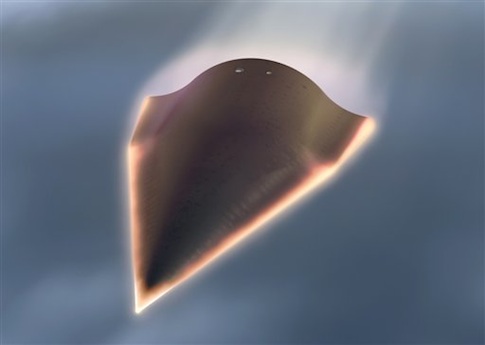
An artistic rendering of a hypersonic aircraft / AP

An artistic rendering of a hypersonic aircraft / AP

BY:
November 30, 2016 5:00 am

The United States is vulnerable to future attack by hypersonic missiles from China and Russia and is falling behind in the technology race to develop both defensive and offensive high-speed maneuvering arms, according to a new Air Force study.

“The People’s Republic of China and the Russian Federation are already flight-testing high-speed maneuvering weapons (HSMWs) that may endanger both forward deployed U.S. forces and even the continental United States itself,” an executive summary of the report says.

“These weapons appear to operate in regimes of speed and altitude, with maneuverability that could frustrate existing missile defense constructs and weapon capabilities.”

Hypersonic missiles are ultra-high speed weapons that travel along the edge of the earth’s atmosphere at speeds above Mach 5, or five times the speed of sound. The missiles also can maneuver to avoid current missile defenses—all of which were developed to hit ballistic missiles with predictable flight paths.

The unclassified summary of the report, “A Threat to America’s Global Vigilance, Reach, and Power: High-Speed, Maneuvering Weapons,” was produced by a blue-ribbon panel of experts for Air Force Studies Board at the National Academies of Science. The summary was made public earlier this month.

It is the first U.S. military study to sound the alarm about an arms race quietly underway for several years to develop hypersonic missiles for both strategic nuclear weapons and conventional rapid strike systems.

Mark J. Lewis, chairman of the panel that produced the report, said the panel concluded that as a result of new hypersonic missiles from Russia and China “the United States may be facing a threat from a new class of weapons that will effectively combine speed, maneuverability, and altitude in ways that could challenge this nation’s tenets of global vigilance, reach, and power.”

“Offense and defense are two sides of the same coin; as in the days of the Cold War, the only reliable deterrent to the use of a hypersonic weapon may in fact be the threat of a corresponding hypersonic countermeasure that might hold at risk the very sites from which the adversaries’ hypersonic strike would originate,” Lewis stated in a forward to the summary.

Lewis urged the U.S. government to engage in a major effort to develop both offensive and defensive means to counter high-speed maneuvering weapons. He criticized what he termed the “relatively leisurely pace of disjointed hypersonics technology development” by the Pentagon.

Additionally, foreign nuclear powers are already designing systems that exploit both the organizational disconnects and current technical limits of U.S. defenses, he said.

Operational flight information for high-speed maneuvering weapons

According to the study, the new class of high-speed maneuvering weapons operate “at the seams” of U.S. defense and national security systems that make them difficult to counter if the weapons are used against U.S. forces or American territory.

“Put another way, while operational doctrine and command structures adequately address traditional atmospheric air attack or exoatmospheric ballistic missile attack, existing doctrine and organizational structure may not be adequate to address the cross-domain threat posed by [high-speed maneuvering weapons],” the report says.

The report says that some may seek to dismiss the new threat as overblown or non-existent and similar to the Eisenhower-era ballistic missile gap because it has taken decades for the hypersonic missile threat to emerge.

Also, some security analysts say the danger can be mitigated by a “silver bullet” solution, or that the threat will never fully emerge.

“However, the value of extreme speed coupled with maneuverability and altitude constitutes a potential threat to U.S. capabilities that should not be discounted or ignored,” the report warns.

In addition to China and Russia, other states are studying hypersonic weapons, including India.

However, China’s multiple tests of a hypersonic glide vehicle dubbed DF-ZF appear to be the more advanced program. The most recent test took place in April.

A Russian official announced in August that developing hypersonic missiles to defeat U.S. missile defenses is a high priority and that the first weapons could be fielded by 2020.

Russia flight-tested its experimental Yu-71 hypersonic glider in April atop a SS-19 missile.

The Pentagon currently has no well-resourced program to either developing hypersonic missiles or to counter them.

Congress has sought to prod the Missile Defense Agency into focusing more resources on hypersonic missiles.

The defense contractor Lockheed Martin is studying an enhanced version of the Terminal High-Altitude Area Defense known as THAAD-ER, as a possible defense against hypersonic missiles.

The Air Force study said the combination of high-speeds and maneuverability increases the lethality of missiles that can be used to widen the range of attack options, and the missiles operate both within the atmosphere and in space in ways that make them much less vulnerable of conventional ballistic and cruise missile defenses.

Two methods for reaching hypersonic speeds are through missile-powered gliders and rocket, ramjet, or scramjet powered versions.

Such missiles also can conduct precision strikes at ultra-high speeds that the report says could include fixed or slow-moving targets such as runways, command and control facilities, or ships at sea.

“Both categories of high-speed weapons may be capable of carrying conventional or nuclear warheads, thereby complicating strategic intent and posture as well as operational identification, response, and engagement,” the report said.

For those that have sought to play down the hypersonic threat, the report warned that “this is no mere tweaking of an existing threat.”

The committee said it was unable to find any formal strategic operational concept or organizational sense of urgency regarding hypersonic weapons, and faulted what the report called a “lack of leadership coordination” at the Pentagon in seeking countermeasures.

An Air Force spokesman said in a statement that hypersonics are “one of the game-changers that provides high-speed options for engaging time-sensitive targets.”

“The Air Force is developing technologies for a high speed strike weapon to enable a responsive, long-range strike capability,” said Capt. Michael Hertzog, the spokesman.

“These weapons can be employed from fighters and bombers and fly at hypersonic speeds to their intended target on the ground.”

The Air Force is developing what it calls a high-speed strike weapon that will travel at hypersonic speeds. The technology involved in the program includes work on explosives with increased effectiveness in the high temperatures produce by hypersonic speed. Other technology involves smaller warheads, advanced materials for lower weight and cost, precision navigation and control, and solid rocket motor technologies to boost performance for air-launched missiles.

The experts on the Air Force study panel included missile specialists from Raytheon, Lockheed, and Boeing, several former Pentagon weapons developers, and Adm. Richard Mies, former commander of the U.S. Strategic Command.


Adios, Fidel, Your Utopia Failed

George F. Will: Fidel Castro and dead utopianism

First Published Nov 26 2016 10:54PM      Last Updated Nov 26 2016 10:54 pm

http://www.sltrib.com/csp/mediapool/sites/Shared/assets/csp/iFrame/blank.html

WASHINGTON • With the end of Fidel Castro’s nasty life Friday night, we can hope, if not reasonably expect, to have seen the last of charismatic totalitarians worshiped by political pilgrims from open societies. Experience suggests there will always be tyranny tourists in flight from what they consider the boring banality of bourgeois society and eager for the excitement of sojourns in “progressive” despotisms that they are free to admire and then leave.

During the 1930s, there were many apologists for Josef Stalin’s brutalities, which he committed in the name of building a workers’ paradise fit for an improved humanity. The apologists complacently said, “You can’t make an omelet without breaking eggs.” To which George Orwell acidly replied: “Where’s the omelet?” With Castro, the problem was lemonade.

Soon after Castro seized power in 1959, Jean-Paul Sartre, the French intellectual whose Stalinist politics were as grotesque as his philosophy was opaque, left Les Deux Magots cafe in Paris to visit Cuba. During a drive, he and Castro stopped at a roadside stand. They were served warm lemonade, which Castro heatedly said “reveals a lack of revolutionary consciousness.” The waitress shrugged, saying the refrigerator was broken. Castro “growled” (Sartre’s approving description): “Tell your people in charge that if they don’t take care of their problems, they will have problems with me.” Sartre swooned:

“This was the first time I understood — still quite vaguely — what I called ‘direct democracy.’ Between the waitress and Castro, an immediate secret understanding was established. She let it be seen by her tone, her smiles, by a shrug of the shoulders, that she was without illusion. And the prime minister … in expressing himself before her without circumlocution, calmly invited her to join the rebellion.”

Another political innovator, Benito Mussolini, called his regime “ennobled democracy,” and as the American columnist Murray Kempton mordantly noted in 1982, photographs of Castro “cutting sugar cane evoke the bare-chested Mussolini plunged into the battle for wheat.” Castro’s direct democracy was parsimonious regarding elections but permissive of shrugs. It did, however, forbid “acts of public destruction,” meaning criticism of communism.

This charge condemned Armando Valladares, then 23, to 22 years in Castro’s prisons. Stalin’s terror was too high a price to pay for a great novel, but at least the world got from it Arthur Koestler’s “Darkness at Noon.” And although Castro’s regime, saturated with sadism, should never have existed, because of it the world got Valladares’s testament to human endurance, his prison memoir “Against All Hope.” Prison food was watery soup laced with glass, or dead rats, or cows’ intestines filled with feces, and Castro’s agents had special uses for the ditch filled with the sewage from 8,000 people.

On April 15, 1959, 15 weeks after capturing Havana, Castro, then 32, landed in Washington at what is now Reagan National Airport. He had been in America in 1948, when he studied English and bought a Lincoln. This time, on April 16, in a concession to bourgeois expectations, he dispatched an aide to buy a comb and toothbrush. His connections to communism? “None,” he said. He endorsed a free press as “the first enemy of dictatorship,” and said free elections were coming soon. Then he was off to a Princeton seminar and a lecture in the chapel at Lawrenceville prep school, well received at both places.

By July red stars were being painted on Cuban military vehicles. Three years later, Soviet ballistic missiles were arriving. A year after that, a Castro admirer murdered the U.S. president whose administration had been interested in, indeed almost obsessed with, removing Castro.

U.S. flings at “regime change” in distant lands have had, to say no more, uneven results, but the most spectacular futility has been 90 miles from Florida. Castro was the object of various and sometimes unhinged U.S. attempts to remove him. After the Bay of Pigs debacle, the Kennedy administration doubled down with Operation Mongoose, which included harebrained assassination plots and a plan skeptics called “elimination by illumination” — having a U.S. submarine surface in Havana harbor and fire star shells into the night sky to convince Catholic Cubans that the Second Coming had come, causing them to rebel against Castro the anti-Christ. Nevertheless, Castro ruled Cuba during 11 U.S. presidencies and longer than the Soviet Union ruled Eastern Europe.

Socialism is bountiful only of slogans, and a Castro favorite was “socialism or death.” The latter came to him decades after the former had made Cuba into a gray museum for a dead utopianism.

The Zumwalt (DDG-1000) Dead In The Water

Most expensive destroyer in Navy history breaks down

FILE - In this Sept. 7, 2016 file photo, the future USS Zumwalt heads down the Kennebec River after leaving Bath Iron Works in Bath, Maine, on it's way to be commissioned. The Zumwalt, the most expensive destroyer ever built for the U.S. Navy, suffered an engineering problem in the Panama Canal Monday, Nov. 21, 2016, and had to be towed to port. Third Fleet spokesman Cmdr. Ryan Perry said a vice admiral has directed the ship to remain at ex-Naval Station Rodman in Panama to address the issues. (AP Photo/Robert F. Bukaty, File)© The Associated Press FILE – In this Sept. 7, 2016 file photo, the future USS Zumwalt heads down the Kennebec River after leaving Bath Iron Works in Bath, Maine, on it’s way to be commissioned. The Zumwalt, the most expensive destroyer ever…PORTLAND, Maine — The most expensive destroyer ever built for the Navy suffered an engineering problem in the Panama Canal and had to be towed to port.

U.S. Third Fleet spokesman Cmdr. Ryan Perry said a vice admiral directed the USS Zumwalt to remain at ex-Naval Station Rodman in Panama to address the issues, which arose on Monday. The ship was built at Bath Iron Works in Maine and is on its way to San Diego.

“The schedule for the ship will remain flexible to enable testing and evaluation in order to ensure the ship’s safe transit to her new home port in San Diego,” Perry said in a statement.

USNI News, a publication of the U.S. Naval Institute, reported on its website that the ship was in the canal when it lost propulsion. Crew also saw water intrusion in bearings that connect electrical motors to drive shafts, the website reported.

USNI News also reported that the Zumwalt suffered minor cosmetic damage. The ship had been scheduled to arrive in San Diego by the end of the year to start the activation of its weapon system, the website reported.

The 610-foot-long warship has an angular shape to minimize its radar signature and is regarded as the most technologically sophisticated destroyer ever built for the Navy. One of its signature features is a new gun system that fires rocket-powered shells up to 63 nautical miles.

The Zumwalt cost more than $4.4 billion and was commissioned last month in Maryland. It also suffered a leak in its propulsion system before it was commissioned. The leak required the ship to remain at Naval Station Norfolk in Virginia longer than expected for repairs.

The ship is part of the first new class of warship built at Bath Iron Works in more than 25 years.

The second Zumwalt-class destroyer, which also cost more than $4.4 billion, was christened in a June ceremony during which U.S. Rep. Bruce Poliquin called it an “extraordinary machine of peace and security.” The third ship is expected to cost a bit less than $3.7 billion.

A spokeswoman for Bath Iron Works said the shipyard was not planning to comment on the breakdown and deferred to the Navy.

One Reason Trump Was Elected. Obama’s Pen!

(WASHINGTON EXAMINER) President Obama has just set a new record for rules and regulations, his administration spitting out 527 pages worth in just one day, as he races to put his fingerprint on virtually every corner of American life and business.

According to the Competitive Enterprise Institute, the administration has just shattered the old record for pages of regulations and rules published by the in-house journal, the Federal Register.

At 81,640 total pages for 2016, it ranks first and 235 pages more than all of those published in 2010, the previous record.

Read more at http://www.wnd.com/2016/11/obama-sets-new-record-for-regulations-527-pages-in-1-day/#4JjvRY0VeUsjIYPc.99

First Lesson of 2016: Be Careful of What You Wish For!!

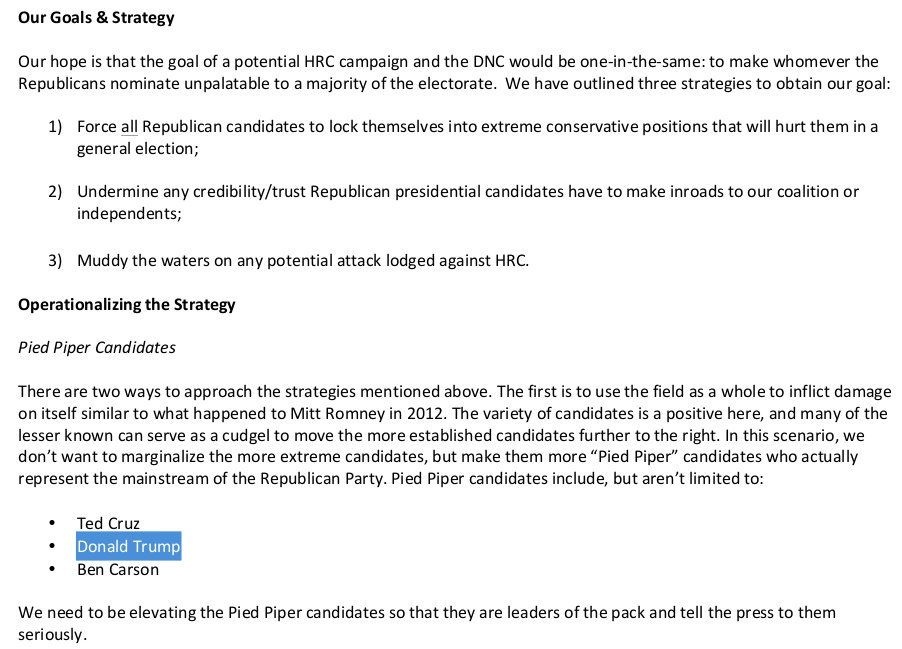
The first lesson of the 2016 Presidential Campaign is that Hillary Clinton chose Donald Trump as her opponent.  This comes from Wikileaks emails from her campaign director, John Podesta who referred to Trump, Ben Carson, and Ted Cruz as the “pied piper” candidates who could be pushed so far right as to be “Unelectable.”

The Clinton campaign’s greatest strength was its control of an adoring , pliable, complicit Media including all of the major networks and cable services. They took the Podesta instructions to heart and created Trump’s candidacy when they could have, by ignoring him, destroyed it.

Clinton’s greatest strength became her biggest issue for other reasons as well. The voters caught on to the horribly one-sided coverage of the campaign which had the result on causing voters to not believe anything she said and to focus on whatever negative news there was about her. Wikileaks indeed!

Clinton would have been better off if Rachel Maddow and those of similar ilk had covered the Wikileaks and controlled the exposure.They didn’t.

Behind this behavior is the Clinton campaign’s huge over-confidence. For example, they had this so-called “Blue Wall” of Electoral votes that included Wisconsin, Pennsylvania, and Michigan, all of which it lost. It had a so-called demographic advantage based on race and gender, and it controlled the media. Moreover, as stated above and shown below, they had effectively chosen the most unelectable candidate, (they thought) from the seventeen Republicans that started the campaign. As was shown, they ignored Clinton’s considerable flaws and ran a political campaign based on the fact she wasn’t Trump. For example, where Obamacare was a huge issue with premiums rising up to 100% and coverage declining, she vaguely stated that she would tinker with it, maybe fix it, but she would keep it. Trump said he would  repeal it. Which message scored?? He had a plan; she had never Trump.

This election was very significant in that it prevented the second Saul Alinsky disciple from the Oval office. Obama was a community organizer when no one knew what that was. It is a Saul Alinsky invention described in “Rules For Radicals,” his 1971 handbook for radical community organizers. Clinton knew Alinsky, worshiped him and wrote the Wellesley thesis on him and his writings. Obama followed the Rules religiously.His response to any situation was pure Alinsky.

This very significant election had this strange start with one candidateThe first lesson of the 2016 Presidential Campaign is that Hillary Clinton chose Donald Trump as her opponent.  This comes from Wikileaks emails from her campaign director, John Podesta who referred to Trump, Ben Carson, and Ted Cruz as the “pied piper” candidates who could be pushed so far right as to be “Unelectable.”   picking her opponent. Here is how it happened.

WikiLeaks: Clinton Campaign Sought to Promote Carson, Trump, Cruz

Image: WikiLeaks: Clinton Campaign Sought to Promote Carson, Trump, Cruz

(AP Images)

By Sandy Fitzgerald   |   Tuesday, 11 Oct 2016 07:31 AM A memo sent out in April 2015 outlined a strategy to boost “Pied Piper” Republican candidates Donald Trump, Ted Cruz, and Ben Carson in an effort to force the whole slate of presidential hopefuls to “lock themselves into extreme conservative positions,” an email hacked from the account of Hillary Clinton’s campaign chairman, John Podesta, reveals.

A memo sent out in April 2015 outlined a strategy to boost “Pied Piper” Republican candidates Donald Trump, Ted Cruz, and Ben Carson in an effort to force the whole slate of presidential hopefuls to “lock themselves into extreme conservative positions,” an email hacked from the account of Hillary Clinton’s campaign chairman, John Podesta, reveals.

“Our hope is that the goal of a potential HRC campaign and the DNC would be one-in-the-same: to make whomever the Republicans nominate unpalatable to a majority of the electorate,” the email, posted byWikiLeaks, which provided a link to the email on Twitter, shows.


The email was sent to Podesta and others involved in the Clinton campaign from the account of mastor@hillaryclinton.com a possible reference to Marissa Astor, listed on Clinton’s campaign outline as a member of her surrogates team, in advance of an upcoming strategy meeting.

The email does not say who wrote the attached memo, which states that most of what was contained in it is “work the DNC is already doing.”

The campaign, in the memo, outlines three strategies:

  • Force all Republican candidates to lock themselves into extreme conservative positions that will hurt them in a general election;
  • Undermine any credibility/trust Republican presidential candidates have to make inroads to our coalition or independents;
  • Muddy the waters on any potential attack lodged against HRC.

Doing that calls for “operationalizing” the “Pied Piper” candidates, and rather than marginalize them, make them appear to be candidates who “represent the mainstream of the Republican Party.”

The candidates included, but were not limited to Trump, Cruz, and Carson, the memo said.

“We need to be elevating the Pied Piper candidates so that they are leaders of the pack and tell the press to them seriously,” the memo said.

The strategy also outlined strategies on other candidates to undermine their credibility among “our coalition,” described as “communities of color, millennials, women” and independent voters.

“The goal here would be to show that they are just the same as every other GOP candidate: extremely conservative on these issues,” said the memo.

For example, the memo called to launch attacks on:

  • Jeb Bush – What to undermine: the notion he is a “moderate” or concerned about regular Americans; perceived inroads with the Latino population;
  • Marco Rubio – What to undermine: the idea he has “fresh” ideas; his perceived appeal to Latinos;
  • Scott Walker – What to undermine: the idea he can rally working- and middle class Americans;
  • Rand Paul – What to undermine: the idea he is a “different” kind of Republican; his stance on the military and his appeal to millennials and communities of color;
  • Bobby Jindal – What to undermine: his “new” ideas;
  • Chris Christie – What to undermine: he tells it like it is.

The memo also called for a “dossier on the GOP candidates” concerning the likely attacks Clinton could face, including on transparency and disclosure, her donors and associations, and her management and business dealings.

“In this regard, any information on scandals or ethical lapses on the GOP candidates would serve well,” the memo concludes. “We won’t be picky.”

_____________________________

Be careful what you wish for, but if the media wasn’t so corrupt, it wouldn’t have happened.